Electrician Apprenticeship Statistics: Apprentices by State, Completion and Hours
- Data
- U.S. Department of Labor RAPIDS registered apprentice records (March 2025 snapshot), with state agency records from Washington, Wisconsin, Connecticut and Maryland
- Period
- FY2015 to FY2024; state agency records 2023-12-31 to 2026-11-05
- Release used
- 2025-03-08
- Next release
- No scheduled update of the downloadable copy; DOL dashboard updates continuously
- Geography
- United States, 50 states and DC
- Sources
- 53 (44 official)
In FY2024, 104,559 people were active in a registered electrician apprenticeship in U.S. Department of Labor records. Counting state registries in Washington, Wisconsin and Connecticut gives 110,215 across federal and state systems (periods FY2024 to 2026). Texas (9,548), California and Florida lead. Most programs require 8,000 hours of paid work.
Texas, California and Florida train the most registered electrician apprentices
Large states lead on raw counts, but the per-worker picture is different: Arkansas, Vermont and Montana register the most apprentices relative to their electrician workforce. Nationally there were 138.1 active apprentices per 1,000 employed electricians.
Active registered apprentice: A person with a signed apprenticeship agreement in a program registered with the U.S. Department of Labor or a State Apprenticeship Agency, counted here if the agreement was active at any point in the federal fiscal year (October 1 to September 30).
The Department of Labor's RAPIDS records list 104,559 active apprentices in core inside, construction and residential electrician titles in FY2024 (military USMAP programs excluded). Texas had 9,548, California 7,354, Florida 6,294, Ohio 5,479 and Maryland 4,848. Source: U.S. Department of Labor RAPIDS records, March 2025 snapshot.
Washington from the L&I registry (2026-10-01); Massachusetts and New Mexico left blank because RAPIDS holds partial data
Source: U.S. Department of Labor RAPIDS records (March 2025 snapshot); Washington L&I; BLS OEWS May 2025
Measured against BLS OEWS May 2025 employment, the FY2024 count equals 138.1 apprentices per 1,000 employed electricians. Arkansas (599.5), Vermont (576.4) and Montana (381.5) rank highest. Outside the partial states, South Carolina (68.2), North Carolina (64.4) and New York (62.5) rank lowest; New York does not use RAPIDS and reports to DOL at a point in time, so its count may not match the fiscal-year basis. State pay levels for the denominator workforce are in our electrician salary by state table.
Show all 51 rows
| State | Registration agency | Active apprentices FY2024 | New FY2024 | Completers FY2024 | Electricians employed May 2025 | Active per 1,000 employed | Union share of active | Data note |
|---|---|---|---|---|---|---|---|---|
| Texas | OA | 9,548 | 5,154 | 779 | 76,770 | 124.4 | 33.9% | |
| California | SAA | 7,354 | 1,915 | 1,339 | 73,310 | 100.3 | 73.3% | |
| Florida | SAA | 6,294 | 2,593 | 747 | 49,700 | 126.6 | 25.0% | |
| Ohio | SAA | 5,479 | 2,004 | 698 | 28,950 | 189.3 | 54.2% | |
| Maryland | SAA | 4,848 | 1,191 | 681 | 13,690 | 354.1 | 44.0% | Does not use RAPIDS (DOL note); state count 4,072 at 2023-12-31 |
| Arkansas | OA | 4,496 | 1,852 | 292 | 7,500 | 599.5 | 8.2% | |
| Indiana | OA | 4,350 | 1,354 | 421 | 19,020 | 228.7 | 51.2% | |
| Virginia | SAA | 4,031 | 1,628 | 374 | 23,630 | 170.6 | 36.0% | |
| Georgia | OA | 3,506 | 1,545 | 412 | 21,650 | 161.9 | 64.9% | |
| Michigan | OA | 3,360 | 1,292 | 407 | 23,530 | 142.8 | 59.3% | |
| Illinois | OA | 3,207 | 1,050 | 540 | 23,120 | 138.7 | 84.7% | |
| Missouri | OA | 2,831 | 1,026 | 284 | 12,780 | 221.5 | 58.9% | |
| Colorado | SAA | 2,768 | 1,352 | 187 | 17,010 | 162.7 | 16.8% | |
| Tennessee | SAA | 2,742 | 1,098 | 333 | 17,070 | 160.6 | 51.7% | |
| Pennsylvania | SAA | 2,694 | 763 | 487 | 22,730 | 118.5 | 68.8% | |
| New York | SAA | 2,510 | 803 | 233 | 40,130 | 62.5 | 81.8% | Does not use RAPIDS; point-in-time upload (DOL note) |
| Oregon | SAA | 2,501 | 315 | 671 | 10,590 | 236.2 | 49.9% | Union flag missing |
| Arizona | SAA | 2,408 | 1,253 | 267 | 21,140 | 113.9 | 45.0% | |
| Wisconsin | SAA | 2,336 | 278 | 341 | 14,310 | 163.2 | 46.9% | Partial; union flag mostly missing; DWD shows 3,406 active contracts in 2025 |
| Iowa | SAA | 2,308 | 853 | 343 | 10,310 | 223.9 | 43.1% | |
| Kentucky | SAA | 1,981 | 686 | 174 | 11,030 | 179.6 | 47.5% | |
| New Jersey | OA | 1,896 | 717 | 333 | 13,520 | 140.2 | 52.1% | |
| Minnesota | SAA | 1,421 | 630 | 246 | 14,350 | 99 | 80.0% | |
| North Carolina | SAA | 1,394 | 227 | 91 | 21,640 | 64.4 | 28.0% | Union flag missing |
| Alabama | SAA | 1,368 | 626 | 186 | 10,900 | 125.5 | 44.4% | |
| Connecticut | SAA | 1,289 | 147 | 349 | 7,710 | 167.2 | 0.2% | Does not use RAPIDS (DOL note); CT DOL records show 2,094 E-2 (2026-11-05) |
| Louisiana | SAA | 1,273 | 535 | 149 | 10,550 | 120.7 | 50.9% | |
| Utah | OA | 1,216 | 526 | 155 | 11,450 | 106.2 | 58.8% | |
| Montana | SAA | 1,049 | 397 | 120 | 2,750 | 381.5 | 18.2% | |
| Nevada | SAA | 1,031 | 300 | 173 | 8,350 | 123.5 | 66.5% | |
| Kansas | SAA | 904 | 427 | 108 | 6,350 | 142.4 | 52.3% | |
| Hawaii | SAA | 845 | 134 | 28 | 3,070 | 275.2 | 49.6% | |
| Mississippi | OA | 760 | 355 | 90 | 6,610 | 115 | 69.1% | |
| Vermont | SAA | 732 | 362 | 67 | 1,270 | 576.4 | 0.4% | |
| Nebraska | OA | 722 | 242 | 95 | 6,440 | 112.1 | 71.7% | |
| Oklahoma | OA | 688 | 350 | 73 | 8,500 | 80.9 | 35.8% | |
| Alaska | OA | 653 | 276 | 101 | 1,870 | 349.2 | 32.3% | |
| Rhode Island | SAA | 645 | 239 | 102 | 2,420 | 266.5 | 25.9% | |
| Idaho | OA | 556 | 266 | 105 | 5,690 | 97.7 | 52.9% | |
| South Carolina | OA | 546 | 303 | 34 | 8,010 | 68.2 | 18.5% | |
| Delaware | SAA | 537 | 190 | 91 | 2,260 | 237.6 | 20.1% | |
| Maine | SAA | 512 | 159 | 30 | 3,780 | 135.4 | 60.4% | |
| New Hampshire | OA | 492 | 173 | 61 | 3,330 | 147.7 | 18.1% | |
| South Dakota | OA | 437 | 209 | 45 | 2,980 | 146.6 | 27.0% | |
| North Dakota | OA | 435 | 167 | 52 | 3,570 | 121.8 | 69.9% | |
| West Virginia | OA | 371 | 124 | 46 | 4,290 | 86.5 | 85.2% | |
| Wyoming | OA | 260 | 124 | 40 | 2,960 | 87.8 | 38.1% | |
| District of Columbia | SAA | 195 | 67 | 9 | 2,440 | 79.9 | 21.5% | Union flag partly missing |
| Massachusetts | SAA | 165 | 69 | 14 | 17,810 | 9.3 | 7.9% | Partial in RAPIDS |
| New Mexico | SAA | 75 | 45 | 3 | 5,020 | 14.9 | 37.3% | Partial in RAPIDS |
| Washington | SAA | 35 | 20 | 3 | 19,380 | 1.8 | 11.4% | Not in RAPIDS; L&I registry shows 3,816 active (2026-10-01) |
Core inside, construction and residential electrician titles; military USMAP excluded. Active counts include anyone active at any point in FY2024. Employment from BLS OEWS May 2025 (SOC 47-2111). OA = federal Office of Apprenticeship registers programs; SAA = State Apprenticeship Agency.
Source: [1][9][6] U.S. Department of Labor, Office of Apprenticeship (hosted on the Colorado Information Marketplace by the Colorado Department of Labor and Employment); U.S. Bureau of Labor Statistics; U.S. Department of Labor, Office of Apprenticeship
State registries add electrician apprentices the federal count misses: 110,215 combined
Seven State Apprenticeship Agency states keep all or part of their records outside RAPIDS. Washington, Wisconsin and Connecticut publish electrician counts that are higher than the federal file; Maryland's is lower; New York, Massachusetts and New Mexico publish none we could open.
| State | State agency | State-published electrician figure | Measure | Date or period | RAPIDS copy FY2024 active | In combined total |
|---|---|---|---|---|---|---|
| Washington | Department of Labor & Industries | 3,816 | Active apprentices, inside, construction and residential titles | 2026-10-01 | 35 | Yes, replaces RAPIDS |
| Wisconsin | Department of Workforce Development | 3,406 | Construction Electrician contracts active in the year | Calendar 2025 | 2,336 | Yes, replaces RAPIDS |
| Wisconsin | Department of Workforce Development | 3,716 | Same measure, partial year | 2026 to 2026-10-01 | No | |
| Connecticut | Department of Labor, Office of Apprenticeship Training | 2,094 | Electrician (E-2) records with status code 3 (inferred active) | 2026-11-05 | 1,289 | Yes, replaces RAPIDS |
| Maryland | Department of Labor, Apprenticeship and Training Program | 4,072 | Active apprentices, Electrician occupation | 2023-12-31 | 4,848 | No, RAPIDS kept |
| New York | Department of Labor | Not published | Statewide only: nearly 17,000 active, 13,601 in construction | July 2026 | 2,510 | No, RAPIDS kept |
| Massachusetts | Division of Apprentice Standards | Not available | Data page returned HTTP 403; no archive copy | Checked 2026-11-05 | 165 | No, still partial |
| New Mexico | Department of Workforce Solutions | Not found | Statewide totals only in news releases | Checked 2026-11-05 | 75 | No, still partial |
Each row keeps its own date. Connecticut does not document its status codes; code 3 is read as active because its statewide total (6,901) matches the state's published figure of about 7,000. Maryland's year-end count is lower than the RAPIDS fiscal-year figure, which counts anyone active at any time, so RAPIDS is kept for Maryland.
Source: [53][45][48][49][50][52][1] Washington State Department of Labor & Industries; Wisconsin Department of Workforce Development, Bureau of Apprenticeship Standards; Connecticut Department of Labor; Office of the Governor of Connecticut; Maryland Department of Labor; New York State Department of Labor; U.S. Department of Labor, Office of Apprenticeship (hosted on the Colorado Information Marketplace by the Colorado Department of Labor and Employment)
Washington's Department of Labor & Industries listed 3,816 active electrician apprentices on 2026-10-01, against 35 in RAPIDS. Wisconsin's Department of Workforce Development counted 3,406 Construction Electrician contracts active in calendar 2025 and 3,716 in 2026 to 2026-10-01, against 2,336 in RAPIDS for FY2024. Connecticut's open registration file holds 2,094 Electrician (E-2) records with status code 3 on 2026-11-05, against 1,289 in RAPIDS (sources: Washington L&I, Wisconsin DWD, Connecticut DOL).
Maryland's latest occupation table counts 4,072 active electrician apprentices on 2023-12-31 (Maryland Apprenticeship and Training Council 2023 report). RAPIDS shows 4,848 for FY2024, 19.1% more, because it counts anyone active at any time in the fiscal year. RAPIDS is kept for Maryland. New York's Department of Labor reports nearly 17,000 active apprentices statewide, 13,601 of them in construction, but no electrician figure (NYSDOL fact sheet, July 2026).
| Component | Apprentices | Period | Source |
|---|---|---|---|
| RAPIDS copy, all states and DC | 104,559 | FY2024 | DOL RAPIDS |
| Less RAPIDS rows for Washington | -35 | FY2024 | DOL RAPIDS |
| Less RAPIDS rows for Wisconsin | -2,336 | FY2024 | DOL RAPIDS |
| Less RAPIDS rows for Connecticut | -1,289 | FY2024 | DOL RAPIDS |
| Plus Washington L&I registry | 3,816 | 2026-10-01 | Washington L&I |
| Plus Wisconsin DWD Construction Electrician contracts | 3,406 | Calendar 2025 | Wisconsin DWD |
| Plus Connecticut DOL Electrician (E-2), status code 3 | 2,094 | 2026-11-05 | Connecticut DOL |
| Combined across federal and state systems | 110,215 | Mixed: FY2024 to 2026-11-05 | ECW calculation (d119) |
| Combined per 1,000 employed electricians | 145.5 | Employment May 2025 | ECW calculation (d121) |
A mixed-period total, not a single-date count. It is 5.4% above the RAPIDS figure. Massachusetts and New Mexico remain partial because no state electrician count could be opened.
Source: [1][53][45][48][9] U.S. Department of Labor, Office of Apprenticeship (hosted on the Colorado Information Marketplace by the Colorado Department of Labor and Employment); Washington State Department of Labor & Industries; Wisconsin Department of Workforce Development, Bureau of Apprenticeship Standards; Connecticut Department of Labor; U.S. Bureau of Labor Statistics
The combined total replaces the RAPIDS rows for Washington, Wisconsin and Connecticut with each state's own count, giving 110,215, or 145.5 per 1,000 employed electricians. It mixes a FY2024 activity count with state counts from 2025 and 2026, so it is a combined figure across federal and state systems, not a single-date stock. Massachusetts and New Mexico remain partial.
| State | State-published figure | Publisher | RAPIDS copy FY2024 active | Reading |
|---|---|---|---|---|
| Tennessee | 2,987 Electrician (interior), 2024 | Tennessee Comptroller (from USDOL RAPIDS) | 2,742 | Close: same underlying system |
| Vermont | 780 Electrician, as of 2025-09-30 | Vermont Department of Labor | 732 | Close: one year later |
| Montana | 1,316 (2024) and 1,387 (2025) Electricians | Montana DLI | 1,049 | Higher: SOC group may include more titles |
| Alaska | 974 Electrician (Interior), any activity in year | Alaska DOLWD | 653 | Higher: counts everyone with activity |
These states register programs in RAPIDS, so their published figures check the federal file. States that run separate registries are in the next table.
Source: [15][14][16][17][1] Tennessee Comptroller of the Treasury, Office of Research and Education Accountability; Vermont Department of Labor; Montana Department of Labor & Industry; Alaska Department of Labor and Workforce Development, Research and Analysis Section; U.S. Department of Labor, Office of Apprenticeship (hosted on the Colorado Information Marketplace by the Colorado Department of Labor and Employment)
Tennessee's Comptroller reports 2,987 Electrician (interior) apprentices in 2024, 3.5 times the next occupation, pipe fitter (849). The RAPIDS copy shows 2,742. Vermont's Department of Labor counted 780 active electrician apprentices on 2025-09-30, 46.3% of all 1,686 active apprentices in the state. Sources: Tennessee Comptroller 2025 update; Vermont Department of Labor 2025 annual report.
Electrician apprenticeship enrollment nearly doubled between FY2015 and FY2024
Active electrician apprentices rose 95.6% and new registrations rose 92.8% over nine fiscal years. Part of the rise reflects more states uploading records to RAPIDS, so the growth rate is an upper bound.
Active at any point in the year, new registrations and completers
Source: U.S. Department of Labor RAPIDS records via data.colorado.gov (March 2025 snapshot)
Active electrician apprentices went from 53,464 in FY2015 to 104,559 in FY2024. New registrations went from 20,075 to 38,696, with a dip to 22,966 in FY2020, and completers went from 4,868 to 13,054. Electricians made up 18.7% of all active non-military registered apprentices in FY2024, against 18.1% in FY2015. Source: U.S. Department of Labor RAPIDS records, March 2025 snapshot.
| Fiscal year | Active (RAPIDS copy) | New | Completers | Electricians' share of all active apprentices | DOL published active count (coverage as labelled) |
|---|---|---|---|---|---|
| FY2011 | 36,624 | ||||
| FY2012 | 36,742 | ||||
| FY2013 | 36,237 | ||||
| FY2014 | 33,389 | ||||
| FY2015 | 53,464 | 20,075 | 4,868 | 18.1% | 37,398 |
| FY2016 | 59,873 | 21,393 | 5,664 | 18.1% | 41,489 |
| FY2017 | 65,783 | 23,822 | 6,936 | 17.5% | 45,264 |
| FY2018 | 74,179 | 28,729 | 8,614 | 17.8% | 43,814 |
| FY2019 | 81,245 | 29,036 | 9,026 | 17.8% | 47,483 |
| FY2020 | 82,420 | 22,966 | 9,584 | 18.0% | 44,547 |
| FY2021 | 85,806 | 27,645 | 11,404 | 18.4% | 71,812 |
| FY2022 | 87,825 | 30,603 | 12,593 | 18.0% | |
| FY2023 | 95,116 | 35,904 | 13,325 | 18.3% | |
| FY2024 | 104,559 | 38,696 | 13,054 | 18.7% |
RAPIDS copy columns: core titles, USMAP excluded, from the March 2025 snapshot. DOL published column: Top Occupations tables, FY2011 to FY2020 federal workload, FY2021 RAPIDS with 48 states. The two series measure different coverage and are not interchangeable.
Source: [1][34][35][36][37][38][39][40][41][42][43][44] U.S. Department of Labor, Office of Apprenticeship (hosted on the Colorado Information Marketplace by the Colorado Department of Labor and Employment); U.S. Department of Labor, Employment and Training Administration; U.S. Department of Labor, Employment and Training Administration; U.S. Department of Labor, Employment and Training Administration; U.S. Department of Labor, Employment and Training Administration; U.S. Department of Labor, Employment and Training Administration; U.S. Department of Labor, Employment and Training Administration; U.S. Department of Labor, Employment and Training Administration; U.S. Department of Labor, Employment and Training Administration; U.S. Department of Labor, Employment and Training Administration; U.S. Department of Labor, Employment and Training Administration; U.S. Department of Labor, Employment and Training Administration
DOL's own published tables give a longer but narrower series. Its Top Occupations tables listed 36,624 active electrician apprentices in FY2011 and 44,547 in FY2020 for the federally administered workload, a 21.6% rise. The FY2021 table, the first to include most State Apprenticeship Agency records, listed 71,812. The Internet Archive holds no FY2022 or later edition of these pages.
Federal workload only through FY2020; FY2021 adds State Apprenticeship Agency records
Source: U.S. Department of Labor, Registered Apprenticeship National Results FY2011 to FY2021 (Internet Archive copies)
The Independent Electrical Contractors (IEC), a merit shop trade association, estimates 124,373 active electrician apprentices in 2024 and projects 135,340 for 2025 from 125,222 counted through 2025-09-23. IEC's count covers all 56 electrician-titled programs in DOL's occupation search, including line, maintenance and other titles this report leaves out; that difference in scope accounts for part of the 19,814 gap. Source: IEC Economic Impact of Merit Shop Electrical Contractors, June 2026.
In Washington 57.7% of electrician apprentices finish, and completers nationally take a median 4.6 years
DOL publishes completion rates by state and industry but not by occupation, so the electrician-specific evidence comes from two state registries and from completion dates in the federal file.
Completion rate (federal definition): The share of an apprenticeship cohort that receives a certificate of completion within one year of the projected completion date, excluding apprentices cancelled during the probationary period (29 CFR Part 29 definitions; Circular 2026-03).
Of 3,775 electrician apprentices who registered in Washington from 2015 to 2019, 2,179 (57.7%) had completed and 1,339 (35.5%) had cancelled by 2026-10-01; 33 were still in training. Completion rose from 49.0% of the 2012 cohort to 60.9% of the 2019 cohort. Source: Washington L&I apprentice records.
Status as of 2026-10-01; later cohorts still have apprentices in training
Source: Washington State Department of Labor & Industries, L&I Apprenticeship Apprentice Details (data.wa.gov)
Wisconsin records point the same way. Of 1,471 Construction Electrician contracts registered from 2014 to 2017, 634 (43.1%) were cancelled. In the older 2006 to 2012 registrations, 61.5% completed. For context, DOL's national average across all occupations was a 46% completion rate and a 41% cancellation rate for FY2014, and Alaska reports that about 30% of its apprentices in all trades finish.
| Source | Cohort or period | Apprentices | Completed | Cancelled | Median years to complete |
|---|---|---|---|---|---|
| Washington, L&I registry | Registered 2015 to 2019 (status at 2026-10-01) | 3,775 | 57.7% | 35.5% | 5.2 |
| Wisconsin DWD, Construction Electrician | Registered 2014 to 2017 (refresh 2026-10-01) | 1,471 | 43.1% | ||
| Wisconsin DWD, Construction Electrician | Registered 2006 to 2012 (refresh 2018-05-01) | 1,668 | 61.5% | ||
| U.S. RAPIDS, electrician completers | Completed FY2023 to FY2024 | 26,319 | 4.6 | ||
| U.S. national average, all occupations | FY2014 cohort (Bulletin 2015-10) | 46% | 41% | ||
| Maryland, all occupations | Exits in calendar 2023 (4,768) | 4,768 | 42.3% of exits | 57.7% of exits | |
| Alaska, all occupations | 2018 to 2025 | About 30% |
No public file gives a national electrician completion rate. The RAPIDS copy holds completers only (all exiter records carry status CO), and DOL's completion dashboard reports by state and industry only. Maryland's row is exits in one year, not a cohort rate.
Source: [1][10][12][13][17][50][5] U.S. Department of Labor, Office of Apprenticeship (hosted on the Colorado Information Marketplace by the Colorado Department of Labor and Employment); Washington State Department of Labor & Industries; Wisconsin Department of Workforce Development, Bureau of Apprenticeship Standards; Wisconsin Department of Workforce Development, Bureau of Apprenticeship Standards; Alaska Department of Labor and Workforce Development, Research and Analysis Section; Maryland Department of Labor; U.S. Department of Labor, Office of Apprenticeship
No other electrician completion figure could be found. The RAPIDS copy has no cancellation records: all 975,874 exiter records carry status CO (completed), checked 2026-11-05. DOL's completion dashboard reports by state and industry, not occupation. Maryland publishes exits for all occupations only: of 4,768 exits in 2023, 42.3% were completions and 57.7% cancellations, a year the state says included a backlog of overdue cancellations (Maryland 2023 report).
In the federal file, the median electrician who completed in FY2023 or FY2024 took 4.6 years from the recorded start date (middle half: 3.8 to 5.1 years). Union completers took a median 5 years and non-union completers 3.9 years, consistent with the five-year class schedules at the Oregon and Cleveland JATCs and the three- to four-year schedules at IEC and ABC-VA. Washington completers from the 2015 to 2019 cohorts took a median 5.2 years.
A rougher pipeline signal: RAPIDS recorded 2.96 new electrician apprentices for every completer in FY2024, and FY2024 completers equalled 56.8% of FY2020's new registrations. That ratio is not a completion rate, because completers started in different years. Demand for those completers is covered in our electrician shortage report.
Union and non-union programs each hold 46.9% of active electrician apprentices
Non-union sponsors run two-thirds of registered electrician programs and register most new apprentices; union programs are fewer, much larger, and produce most completers. Both routes lead to the same registered credential.
| Program type (RAPIDS union flag) | Programs | Share of programs | Active apprentices | Share of active | Share of new | Share of completers | Median active apprentices per program |
|---|---|---|---|---|---|---|---|
| Union | 487 | 12.7% | 49,036 | 46.9% | 38.9% | 54.9% | 30 |
| Non-union | 2,548 | 66.6% | 49,012 | 46.9% | 58.6% | 36.4% | 2 |
| Not specified | 793 | 20.7% | 6,511 | 6.2% | 2.5% | 8.7% | 1 |
| All | 3,828 | 100% | 104,559 | 100% | 100% | 100% | 2 |
Programs with at least one active core electrician apprentice in FY2024. The union flag does not separate association programs (IEC, ABC) from single-employer programs.
Source: [1] U.S. Department of Labor, Office of Apprenticeship (hosted on the Colorado Information Marketplace by the Colorado Department of Labor and Employment)
In FY2024, 487 union-flagged programs (12.7% of 3,828) held 49,036 active electrician apprentices, and 2,548 non-union programs (66.6%) held 49,012. The median union program had 30 active apprentices; the median non-union program had 2. The largest tenth of programs held 83.2% of all active apprentices. Source: DOL RAPIDS records.
Share of active, new and completing apprentices; remainder has no union flag
Source: U.S. Department of Labor RAPIDS records via data.colorado.gov (March 2025 snapshot)
Non-union programs registered 58.6% of new electrician apprentices in FY2024 and union programs 38.9%; union programs accounted for 54.9% of completers and non-union programs 36.4%. From FY2020 to FY2024 the number of non-union programs grew 23.7% and union programs 3.0%; new registrations grew 82.2% and 77.2% respectively.
State registries show the same split. In Washington, 5 union-flagged programs train 1,986 active electrician apprentices (52.0%) and 28 non-union programs train 1,830 (48.0%); 25 of the 33 programs were approved in 2020 or later. In Alaska's 2025 sponsor table, Associated Builders and Contractors of Alaska listed 471 electrician apprentices (52.9% of listed sponsors), the Alaska Joint Electrical Apprenticeship and Training Trust 279 (31.3%) and 19 employer programs 140 (15.7%).
The national associations publish their own counts. IEC reported 21,605 active apprentices in its chapter programs in 2025 and estimates that 50% of electrician apprentices train in merit shop programs and 44% in union programs. The IBEW-NECA electrical training ALLIANCE says its local programs have trained over 350,000 apprentices to journeyman status. Apprentice wage scales in union programs are covered in our IBEW pay scale report; this report does not rank programs.
An electrician apprenticeship usually means 8,000 hours of paid work and 576 to 900 classroom hours
Federal rules set a floor of 2,000 hours; inside electrician programs of every sponsor type reviewed set 8,000 hours of on-the-job learning, while classroom hours range from about 576 to 900. Residential programs are shorter.
| Program | Sponsor type | On-the-job hours | Related (classroom) instruction hours | Term | Source id |
|---|---|---|---|---|---|
| Federal floor (29 CFR 29) | Any registered program | At least 2,000 | 144 per year recommended | Set by occupation | s7 |
| Inside electrician, union JATC (Oregon NECA-IBEW) | Joint labor-management | 8,000 | 180 per year minimum; 900 over 5 class years | 5 years of classes | s18 |
| Inside electrician, union JATC (Cleveland) | Joint labor-management | 8,000 | 820 minimum | 5 years | s32 |
| Inside electrician, Area IV Independent TAC (Oregon) | Training committee | 8,000 | 144 per year minimum | Not stated in hours table | s19 |
| Inside electrician, Oregon Electricians MGSC | Training committee | 8,000 | 144 per year minimum | Not stated in hours table | s20 |
| Electrical apprenticeship, IEC (national FAQ) | Merit shop association | 8,000 | 576 | About 4 years | s27 |
| Electrical apprenticeship, ABC-VA Hampton Roads | Merit shop association | 8,000 | 600 | 4 years | s30 |
| Electrical apprenticeship, ABC-VA Central Virginia evening | Merit shop association | 8,000 | 600 | 3 years | s31 |
| Electrician, IREC/SEIA national guidelines | National guideline standards | 8,000 | 576 | Time-based | s22 |
| Electrician, Learning Alliance national guidelines | National guideline standards | 8,000 | 660 | Time-based | s23 |
| Residential wireman, electrical training ALLIANCE | Joint labor-management | 4,800 | 160 per year minimum; 480 over 3 class years | 3 years of classes | s21 |
| Completed 8,000-hour apprentices, Washington (recorded) | All sponsors | 8,044 median | 835 median | 5.2 years median | s10 |
Published standards and applications; local programs may set higher minimums. Washington row is recorded hours for completers, not a rule.
Source: [7][18][32][19][20][27][30][31][22][23][21][10] U.S. Department of Labor via eCFR; Oregon Bureau of Labor and Industries, Apprenticeship and Training Division; Cleveland Building and Construction Trades Council; Oregon Bureau of Labor and Industries, Apprenticeship and Training Division; Oregon Bureau of Labor and Industries, Apprenticeship and Training Division; Independent Electrical Contractors (IEC); Associated Builders and Contractors, Virginia Chapter (ABC-VA); Associated Builders and Contractors, Virginia Chapter (ABC-VA); U.S. Department of Labor, Office of Apprenticeship; U.S. Department of Labor, Office of Apprenticeship; U.S. Department of Labor, Office of Apprenticeship; Washington State Department of Labor & Industries
Published standards and applications; hours outside paid work
Sources: Oregon BOLI standards; Cleveland Building Trades; DOL bulletins 2026-03, 2026-26, 2020-54; ABC-VA; IEC; 29 CFR 29.5
Under the program standards rule in 29 CFR Part 29, a registered program must spell out on-the-job learning of at least 2,000 hours for a time-based term, provide related instruction (144 hours a year is recommended), pay a progressively increasing wage schedule and limit probation to 25% of the term or one year, whichever is shorter. BLS describes a typical electrician apprenticeship as 4 or 5 years with about 2,000 hours of paid on-the-job training each year.
Recorded hours line up with the published rules. Washington's 8,078 completed apprentices on 8,000-hour terms logged a median 8,044 on-the-job hours and 835 hours of related instruction. Of Washington's active electrician apprentices, 3,724 are on 8,000-hour terms and 78 on 4,000-hour residential terms.
State licensing boards set their own experience-hour rules for journeyman exams; those are in our electrical license lookup. Tuition and the school route are compared in our electrician school cost report.
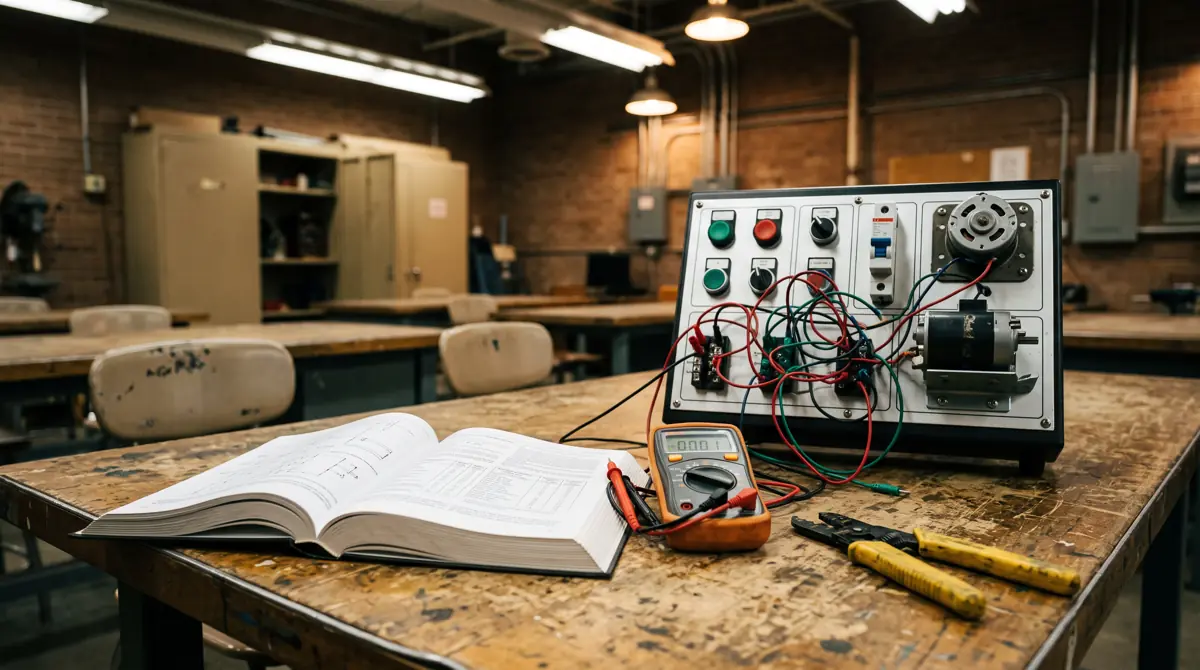
How to get an electrical apprenticeship: age, diploma, algebra, aptitude test and interview
Entry steps are similar across union and non-union routes; the main differences are the aptitude test and whether you must already have an electrical employer.
- Meet the age floor. Federal rules allow registered apprentices from age 16, but electrician programs usually require 18: the electrical training ALLIANCE, IEC and ABC-VA all list 18, and the Oregon and Cleveland JATCs accept applications at 17 with registration at 18.
- Hold a high school diploma or GED. The ALLIANCE, IEC, ABC-VA, Cleveland JATC and Oregon standards reviewed here all list it.
- Show basic algebra. IBEW-NECA JATCs typically require one year of high school algebra; ABC-VA requires a math assessment for incoming students.
- Pass the selection steps. JATCs use the electrical training ALLIANCE aptitude test and an interview (Cleveland JATC). ABC-VA requires applicants to be employed in the electrical field and limits its program to apprentices of licensed Virginia electrical contractors.
- Register and start work. The apprentice signs a registered apprenticeship agreement and serves a probationary period of up to one year (2,000 OJT hours or one year at IEC Dallas; the first 2,000 OJT hours at the Oregon NECA-IBEW JATC).
Fees are small where published: a $35.00 application fee at the Oregon NECA-IBEW JATC and a $40.00 processing fee at the Cleveland JATC. Steps before applying, including pre-apprenticeship and licensing, are covered in our guide on how to become an electrician. Women's share of electrician apprentices is covered in our female electricians report, and line apprenticeships in our lineman school report.
How we ranked the states
Active electrician apprentices per 1,000 employed electricians, by state
Formulastate FY2024 active apprentices / state OEWS May 2025 electrician employment x 1,000
Inputs: fact rows for each state's active count and OEWS employment (fact sheet rows)
Result: U.S. 138.1; highest Arkansas 599.5, Vermont 576.4, Montana 381.5
High ratios appear in Arkansas and Vermont, where union programs hold 8.2% and 0.4% of active apprentices; low ratios appear in SAA states whose uploads are partial.
Limitations: Fiscal-year activity counts over May jobs; location bases differ; partial states excluded from the map.
New apprentices and completers per year, FY2015 to FY2024
FormulaRAPIDS rows by fiscal year, core titles, USMAP excluded
Inputs: fact rows FY2015 to FY2024 active, new, completers (fact sheet rows)
Result: New 20,075 to 38,696; completers 4,868 to 13,054; 2.96 new per completer in FY2024
Entries have grown faster than completions since FY2020, so completions should rise as the FY2021 to FY2024 cohorts finish.
Limitations: Coverage of SAA states improved over time.
Completion and cancellation shares
Formulacompleted / registered and cancelled / registered by registration cohort
Inputs: Washington L&I and Wisconsin DWD fact rows (fact sheet rows)
Result: Washington 2015 to 2019: 57.7% completed, 35.5% cancelled; Wisconsin 2014 to 2017: 43.1% cancelled
Where electrician cohort data exist, completion runs from 57.7% to 61.5%, above the 46% all-occupation national average DOL reported for FY2014.
Limitations: Two states only; transfers count as not completed in Washington.
Registered electrician programs by sponsor type
Formulacount(distinct program_id) by isunion, FY2024
Inputs: RAPIDS program fact rows (fact sheet rows)
Result: 487 union, 2,548 non-union, 793 unflagged; medians 30 and 2 apprentices
Union-flagged training is concentrated in a few large programs; non-union training is spread across association programs and many small employer programs.
Limitations: The flag does not identify IEC or ABC affiliation.
Typical on-the-job and classroom hours
FormulaPublished minimums; classroom totals = hours per year x class years where only annual minimums are given
Inputs: fact rows for 29 CFR 29, Oregon standards, bulletins, sponsor documents (fact sheet rows)
Result: 8,000 OJT hours for inside electrician programs; 576 to 900 classroom hours; residential wireman 4,800 OJT and 480 classroom hours
Sponsor type changes classroom hours and calendar length more than work hours.
Limitations: Local programs may exceed minimums; selection of programs is illustrative, not a census.
Electrician apprentices combined across federal and state systems
FormulaRAPIDS FY2024 active - RAPIDS rows for WA, WI, CT + state agency counts for WA, WI, CT
Inputs: derived d119 to d121; fact sheet rows for RAPIDS FY2024 national and state counts and state agency counts (fact sheet rows)
Result: 110,215 combined (5.4% above RAPIDS); 145.5 per 1,000 employed electricians
The federal count understates registered electrician apprentices by a few percent; the gap is concentrated in Washington, Wisconsin and Connecticut.
Limitations: Mixed periods (FY2024 to 2026-11-05); Connecticut status code inferred; Massachusetts and New Mexico still partial; New York and Maryland use RAPIDS.
State by state
- 104,559 people were active in registered electrician apprenticeships at some point in FY2024 in DOL RAPIDS records (U.S., military excluded).[1]
- Combined across federal and state systems, 110,215 electrician apprentices were registered: RAPIDS FY2024 with Washington (2026-10-01), Wisconsin (2025) and Connecticut (2026-11-05) state counts substituted, 5.4% above RAPIDS alone.[1][53][45][48]
- Active electrician apprentices rose 95.6% from 53,464 in FY2015 to 104,559 in FY2024 (U.S., RAPIDS states).[1]
- New electrician apprentice registrations reached 38,696 in FY2024, up 68.5% from FY2020 (U.S.).[1]
- 13,054 electrician apprentices completed in FY2024, against 4,868 in FY2015 (U.S.).[1]
- Electricians were 18.7% of all active non-military registered apprentices in FY2024 (U.S.).[1]
- Texas (9,548), California (7,354) and Florida (6,294) had the most active electrician apprentices in FY2024.[1]
- Arkansas had 599.5 active electrician apprentices per 1,000 employed electricians in FY2024, the highest rate; the U.S. figure was 138.1.[1][9]
- Washington, which keeps its own registry, had 3,816 active electrician apprentices on 2026-10-01, while RAPIDS shows 35.[10][1]
- 57.7% of Washington electrician apprentices registered in 2015 to 2019 completed and 35.5% cancelled (status 2026-10-01).[10]
- Electrician completers in FY2023 and FY2024 took a median 4.6 years from recorded start (U.S.).[1]
- Union and non-union programs each held 46.9% of active electrician apprentices in FY2024; non-union programs registered 58.6% of new apprentices (U.S.).[1]
- Non-union sponsors ran 66.6% of 3,828 registered electrician programs in FY2024; the median union program had 30 apprentices, the median non-union program 2.[1]
- Inside electrician programs of every sponsor type reviewed require 8,000 hours of on-the-job learning; classroom minimums run from 576 hours (IEC, IREC/SEIA) to 900 (Oregon NECA-IBEW JATC).[18][27][22][30][32]
- Wisconsin DWD counted 3,406 active Construction Electrician contracts in calendar 2025, 45.8% more than the 2,336 Wisconsin electrician apprentices in RAPIDS for FY2024.[45][1]
In short
- DOL RAPIDS records show 104,559 active registered electrician apprentices in FY2024, 38,696 new registrations and 13,054 completers.
- No FY2025 electrician count could be read from a DOL file on 2026-11-05, so FY2024 remains the latest complete year.
- Active electrician apprentices rose 95.6% from FY2015, partly because more states now upload records.
- Texas, California and Florida have the most apprentices; Arkansas, Vermont and Montana have the most per 1,000 employed electricians.
- State registries hold apprentices RAPIDS lacks: Washington 3,816 (2026-10-01), Wisconsin 3,406 Construction Electrician contracts (2025) and Connecticut 2,094 (2026-11-05), for a combined 110,215 across federal and state systems.
- In Washington, 57.7% of 2015 to 2019 registrants completed; completers nationally took a median 4.6 years.
- Union and non-union programs each hold 46.9% of active apprentices; non-union sponsors run 66.6% of programs and sign up most new entrants.
- Most programs require 8,000 hours of paid work plus 576 to 900 classroom hours; residential programs need 4,000 to 4,800 hours.
What people search for
How long is an electrician apprenticeship?
Usually four or five years. BLS describes 4 or 5 years; completers in FY2023 and FY2024 took a median 4.6 years from recorded start, 5 in union and 3.9 in non-union programs.
How do you get an electrical apprenticeship?
Be 18 (some JATCs take applications at 17), hold a diploma or GED, show a year of algebra, then pass the sponsor's selection: an aptitude test and interview at JATCs, or employment with a sponsoring contractor in most merit shop programs.
Do electrician apprentices get paid?
Yes. Registered programs must pay a progressively increasing wage schedule under 29 CFR Part 29, and BLS notes apprentice pay rises as skills grow. Union scale detail is in our IBEW pay scale report.
Union vs non-union electrician apprenticeship?
Both lead to a registered completion certificate and most require 8,000 work hours. Union JATCs are fewer and larger (median 30 apprentices) with more classroom hours; non-union programs are more numerous and registered 58.6% of FY2024 entrants.
How many hours is an electrician apprenticeship?
Typically 8,000 hours of on-the-job learning plus 576 to 900 hours of related instruction, depending on the sponsor. Residential programs run 4,000 to 4,800 hours. The federal floor is 2,000 hours.
Common questions
How many electrician apprentices are there in the US?
U.S. Department of Labor RAPIDS records list 104,559 active registered apprentices in inside, construction and residential electrician titles in FY2024. Replacing the RAPIDS rows for Washington, Wisconsin and Connecticut with state counts gives 110,215 across federal and state systems (FY2024 to 2026). IEC estimates 124,373 for 2024 using a wider set of titles.
Which state has the most electrician apprentices?
Texas, with 9,548 active in FY2024, followed by California (7,354) and Florida (6,294). Relative to its electrician workforce, Arkansas ranks first at 599.5 apprentices per 1,000 employed electricians.
What percentage of electrician apprentices complete the program?
No national electrician figure is published, and the RAPIDS copy holds no cancellation records. In Washington, 57.7% of 2015 to 2019 registrants completed and 35.5% cancelled. In Wisconsin, 43.1% of 2014 to 2017 Construction Electrician registrations were cancelled.
How many new electrician apprentices start each year?
RAPIDS records show 38,696 new electrician apprentices in FY2024, up 68.5% from 22,966 in FY2020. IEC projects 49,150 new electrician apprentices for 2025 on its wider definition.
How many electrician apprentices finish each year?
13,054 electrician apprentices completed in FY2024 in RAPIDS records, up from 4,868 in FY2015. That is about one completer for every 2.96 new registrations in the same year.
Are most electrician apprentices in union programs?
In FY2024 the split was even: 46.9% union and 46.9% non-union, with 6.2% unflagged. Non-union programs registered 58.6% of new apprentices; union programs produced 54.9% of completers.
How many electrician apprenticeship programs are there?
3,828 registered programs had at least one active electrician apprentice in FY2024 in RAPIDS: 487 union, 2,548 non-union and 793 without a flag. 2,558 had fewer than 5 apprentices.
What is the minimum age for an electrician apprenticeship?
Federal rules allow registered apprentices from 16, but electrician programs usually require 18. The Oregon and Cleveland JATCs accept applications at 17 and register apprentices at 18.
Is a residential electrician apprenticeship shorter?
Yes. The IBEW-NECA Residential Wireman standard requires at least 4,800 on-the-job hours and three years of classes at 160 hours a year, against 8,000 hours for inside electrician programs. Washington's residential terms are 4,000 to 4,200 hours.
Where does the national electrician apprentice data come from?
From RAPIDS, the Department of Labor's registration database, which most states use. Washington, Wisconsin, Connecticut, Maryland and New York keep all or part of their records in state systems. DOL's interactive dashboard holds data through 2026-09-03, but the latest downloadable file runs to March 2025, so FY2024 is the latest complete year.
Get the data
Every table in this report is available as a CSV under CC BY 4.0. The fact sheet lists each value with its source URL and access date.
- derived_metrics.csv (CSV)
- fact_sheet.csv (CSV)
- Active registered electrician apprentices by state, FY2024, with apprentices per 1,000 employed electricians (CSV)
- Registered electrician apprentices by fiscal year: active, new and completers (CSV)
- How many electrician apprentices finish: completion, cancellation and time to complete (CSV)
- Electrician apprenticeship sponsors by union status, FY2024 (CSV)
- Hours an electrician apprenticeship requires, by program type (CSV)
- States that publish their own electrician counts and also use RAPIDS (CSV)
- State apprenticeship agency states: electrician counts from the state's own records (CSV)
- Electrician apprentices combined across federal and state systems (CSV)
Cite this report
The figures to cite first
- 104,559 people were active in a registered electrician apprenticeship in FY2024, according to U.S. Department of Labor RAPIDS records.[1]
- 110,215 electrician apprentices combined across federal and state systems, FY2024 RAPIDS plus Washington, Wisconsin and Connecticut registries (ECW calculation).[1][53][45][48]
- The number of active electrician apprentices in DOL records rose 95.6% between FY2015 and FY2024.[1]
- In Washington, 57.7% of electrician apprentices who registered from 2015 to 2019 completed their apprenticeship.[10]
Quotable figures
- 104,559 people were active in a registered electrician apprenticeship in FY2024, according to U.S. Department of Labor RAPIDS records.[1]
- Counting state registries in Washington, Wisconsin and Connecticut, 110,215 electrician apprentices were registered across federal and state systems (FY2024 to 2026).[1][53][45][48]
- The number of active electrician apprentices in DOL records rose 95.6% between FY2015 and FY2024.[1]
- Electrician apprenticeship is split evenly: union and non-union programs each held 46.9% of active apprentices in FY2024.[1]
- Non-union programs registered 58.6% of new electrician apprentices in FY2024, while union programs produced 54.9% of completers.[1]
- In Washington, 57.7% of electrician apprentices who registered from 2015 to 2019 completed their apprenticeship.[10]
- The median electrician apprentice who completed in FY2023 or FY2024 took 4.6 years.[1]
- Electrician apprenticeships of every sponsor type reviewed require 8,000 hours of paid on-the-job learning.[18][27][30][22]
Summary for editors
About 104,559 people were active in a registered electrician apprenticeship in the United States in FY2024, according to Department of Labor RAPIDS records analysed by Electrical Contractors and Wiring. That is 95.6% more than in FY2015, and electricians make up 18.7% of all non-military registered apprentices. The federal file misses part of the system: replacing its rows for Washington, Wisconsin and Connecticut with those states' own counts gives 110,215 across federal and state systems, for periods from FY2024 to 2026. Texas (9,548), California (7,354) and Florida (6,294) lead on counts. Union and non-union programs each train 46.9% of apprentices, but non-union programs signed up 58.6% of FY2024 entrants. No national electrician completion rate is published; in Washington, 57.7% of 2015 to 2019 registrants finished. Most programs require 8,000 hours of paid work.
Headlines the data supports
- 104,559 Americans were in an electrician apprenticeship in FY2024
- Electrician apprenticeships nearly doubled in a decade, up 95.6%
- Union and non-union programs now train equal shares of electrician apprentices
- Non-union programs sign up 58.6% of new electrician apprentices
- 57.7% of Washington electrician apprentices finish, state records show
Citation
Electrical Contractors and Wiring. (2026). Electrician Apprenticeship Statistics: Apprentices by State, Completion and Hours. Retrieved from https://electricalcontractorsandwiring.com/data/electrician-apprenticeship/
Reuse
Data and tables are licensed CC BY 4.0. Attribution: “Source: Electrical Contractors and Wiring, Electrician Apprenticeship Statistics: Apprentices by State, Completion and Hours” with a link to this page.
How we built this report
Selection. Counts come from the Department of Labor's RAPIDS registration records, published by DOL on the Colorado Information Marketplace (dataset bgbq-h7em, snapshot through March 2025). On 2026-11-05 we searched again for FY2025 electrician counts: the apprenticeship.gov dashboards serve data only through Tableau views behind a bot check, the dol.gov fiscal-year pages return HTTP 403 and have no archived edition after FY2021, the July 2026 data.colorado.gov entry is a link to the dashboard, and the catalog.data.gov records list no download. FY2024 is therefore the latest complete fiscal year. State agency records (Washington L&I, Wisconsin DWD, Connecticut DOL, Maryland Department of Labor, plus Vermont, Tennessee, Montana and Alaska) were added where they publish electrician figures. Hours and entry rules come from 29 CFR Part 29, DOL bulletins, Oregon BOLI registered standards, and published sponsor applications.
Inclusion. 'Electrician' means inside, construction, general and residential electrician titles (for example ELECTRICIAN (Alternate Title: Interior Electrician), Inside Electrician, Construction Electrician, Residential Wireman). Line, substation, maintenance, industrial, marine, aircraft, meter and low-voltage titles are excluded; maintenance and industrial titles added 3,010 active apprentices in FY2024 and are reported only as a sensitivity. Military USMAP records are excluded. The title list is in scripts/classify.py.
Definitions. 'Active' counts anyone whose agreement was active at any time in the fiscal year, so it is larger than a point-in-time count. 'Completers' come from the exiter table (status CO). The RAPIDS copy holds no cancellation records, so completion and cancellation shares come from Washington and Wisconsin records. Union status is DOL's isunion flag; it does not separate association programs (IEC, ABC chapters) from single-employer programs.
Conflicts. Federal and state counts are shown side by side (tables t6 and t7). The combined total (table t8) replaces the RAPIDS rows for Washington, Wisconsin and Connecticut, where the state count is higher and the federal file is known to be partial, and keeps RAPIDS for Maryland and New York. Each component keeps its own period, and the total is labelled as combined across federal and state systems. DOL's FY2011 to FY2021 Top Occupations tables use changing coverage and are shown as a separate series. IEC's national estimates use a wider title set and a growth projection for 2025 and are reported as estimates, not counts.
Derived metrics. Apprentices per 1,000 employed electricians divide FY2024 active counts by BLS OEWS May 2025 employment for SOC 47-2111 in the same state. Apprentice counts follow the apprentice's location, employment follows the workplace. Washington's rate uses the L&I count on 2026-10-01. Formulas and inputs are in derived_metrics.csv; scripts are in scripts/.
Limitations. RAPIDS is partial for Washington, Massachusetts, New Mexico, Wisconsin and Connecticut and lacks union flags for several SAA uploads. Connecticut's status codes are undocumented. Start dates can reflect transfers, which shortens measured completion times. Wisconsin completion rates come from a file last refreshed in 2018. Nothing here is legal, career or financial advice; check requirements with the program sponsor and your state licensing board. Last updated 2026-11-05.
This report presents published data with its limitations. It is not legal, financial or investment advice.
Sources by tier
Tier 1: primary and official sources (44)
- [1] U.S. Department of Labor, Office of Apprenticeship (hosted on the Colorado Information Marketplace by the Colorado Department of Labor and Employment). CDLE – apprenticeship.gov – Apprentices by Location (March 2025), RAPIDS records FY2015 to FY2025 (dataset bgbq-h7em). FY2015 to FY2024 complete; FY2025 through March 2025 (rechecked 2026-11-05: no newer snapshot). Accessed 2026-11-02.
- [2] U.S. Department of Labor, Office of Apprenticeship. Apprentices by State dashboard and Data and Statistics pages. Pages as accessed 2026-11-02. Accessed 2026-11-02.
- [3] U.S. Department of Labor, Office of Apprenticeship. Apprentice Completion Rate Analysis (BETA). FY2013 to FY2024. Accessed 2026-11-02.
- [4] U.S. Department of Labor, Employment and Training Administration. Office of Apprenticeship Circular No. 2026-03: Registered Apprenticeship Program Completion Rates (March 9, 2026). 2026. Accessed 2026-11-02.
- [5] U.S. Department of Labor, Office of Apprenticeship. Bulletin 2015-10: Program Performance, Calculation of Registered Apprenticeship Program Completion Rates. FY2005 to FY2014. Accessed 2026-11-02.
- [6] U.S. Department of Labor, Office of Apprenticeship. Apprenticeship System: Office of Apprenticeship and State Apprenticeship Agency states (State Offices page). Page as accessed 2026-11-02. Accessed 2026-11-02.
- [7] U.S. Department of Labor via eCFR. 29 CFR Part 29, Labor Standards for the Registration of Apprenticeship Programs (eCFR, as of 2026-10-01). Regulation in force 2026-10-01. Accessed 2026-11-02.
- [8] U.S. Bureau of Labor Statistics. Occupational Outlook Handbook: Electricians. 2025 to 2035 edition. Accessed 2026-11-02.
- [9] U.S. Bureau of Labor Statistics. Occupational Employment and Wage Statistics, May 2025 state file (oesm25st.zip), SOC 47-2111 Electricians. May 2025. Accessed 2026-11-02.
- [10] Washington State Department of Labor & Industries. L&I Apprenticeship Apprentice Details (dataset mcr6-ujqw). Records through 2026-10-01. Accessed 2026-11-02.
- [11] Washington State Department of Labor & Industries. L&I Apprenticeship Program Details (dataset 4mxd-hz2q). Records through 2026-10-01. Accessed 2026-11-02.
- [12] Wisconsin Department of Workforce Development, Bureau of Apprenticeship Standards. Apprenticeship Cancellation Rates By Trade, 2014 to 2026 (refresh date 10/1/2026). Calendar years 2014 to 2026. Accessed 2026-11-02.
- [13] Wisconsin Department of Workforce Development, Bureau of Apprenticeship Standards. Apprenticeship Completion Rates, 2006 to 2018 (refresh date 5/1/2018). Registration years 2006 to 2018. Accessed 2026-11-02.
- [14] Vermont Department of Labor. 2025 Registered Apprenticeship Program Annual Report. Federal FY2025 (as of 2025-09-30). Accessed 2026-11-02.
- [15] Tennessee Comptroller of the Treasury, Office of Research and Education Accountability. Apprenticeship in Tennessee: 2025 Update. 2023 and 2024. Accessed 2026-11-02.
- [16] Montana Department of Labor & Industry. Number of Apprenticeships by Occupation (2024, 2025, 2026). 2024 to 2026 (file created 2026-03-26). Accessed 2026-11-02.
- [17] Alaska Department of Labor and Workforce Development, Research and Analysis Section. Alaska Apprenticeships (published April 2026). State fiscal year 2025. Accessed 2026-11-02.
- [18] Oregon Bureau of Labor and Industries, Apprenticeship and Training Division. Standards of Apprenticeship, NECA-IBEW Electrical JATC, Inside Electrician (MA# 1004). Last revised 2023-04-01; wage table dated 2026-01-01. Accessed 2026-11-02.
- [19] Oregon Bureau of Labor and Industries, Apprenticeship and Training Division. Standards of Apprenticeship, Area IV Independent TAC, Inside Electrician (MA# 4015). Standards as posted 2026-11-02. Accessed 2026-11-02.
- [20] Oregon Bureau of Labor and Industries, Apprenticeship and Training Division. Standards of Apprenticeship, Oregon Electricians MGSC, Inside Electrician (MA# 8003). Standards as posted 2026-11-02. Accessed 2026-11-02.
- [21] U.S. Department of Labor, Office of Apprenticeship. Bulletin 2020-54: Revised National Guidelines for Apprenticeship Standards for the electrical training ALLIANCE, Residential Wireman. March 26, 2020. Accessed 2026-11-02.
- [22] U.S. Department of Labor, Office of Apprenticeship. Bulletin 2026-03: Revised Appendix A to National Guidelines for Apprenticeship Standards for IREC and SEIA (Electrician). November 25, 2025. Accessed 2026-11-02.
- [23] U.S. Department of Labor, Office of Apprenticeship. Bulletin 2026-26: Revision to Appendix A, National Guidelines Standards for Learning Alliance (Electrician). February 17, 2026. Accessed 2026-11-02.
- [24] U.S. Department of Labor, Office of Apprenticeship. Bulletin 2025-39: Revised National Guidelines for Apprenticeship Standards, Area-wide JATCs representing NECA and IBEW. January 21, 2025. Accessed 2026-11-02.
- [34] U.S. Department of Labor, Employment and Training Administration. Registered Apprenticeship National Results, Fiscal Year 2011 (Internet Archive copy; live page returned HTTP 403). FY2011. Accessed 2026-11-02.
- [35] U.S. Department of Labor, Employment and Training Administration. Registered Apprenticeship National Results, Fiscal Year 2012 (Internet Archive copy; live page returned HTTP 403). FY2012. Accessed 2026-11-02.
- [36] U.S. Department of Labor, Employment and Training Administration. Registered Apprenticeship National Results, Fiscal Year 2013 (Internet Archive copy; live page returned HTTP 403). FY2013. Accessed 2026-11-02.
- [37] U.S. Department of Labor, Employment and Training Administration. Registered Apprenticeship National Results, Fiscal Year 2014 (Internet Archive copy; live page returned HTTP 403). FY2014. Accessed 2026-11-02.
- [38] U.S. Department of Labor, Employment and Training Administration. Registered Apprenticeship National Results, Fiscal Year 2015 (Internet Archive copy; live page returned HTTP 403). FY2015. Accessed 2026-11-02.
- [39] U.S. Department of Labor, Employment and Training Administration. Registered Apprenticeship National Results, Fiscal Year 2016 (Internet Archive copy; live page returned HTTP 403). FY2016. Accessed 2026-11-02.
- [40] U.S. Department of Labor, Employment and Training Administration. Registered Apprenticeship National Results, Fiscal Year 2017 (Internet Archive copy; live page returned HTTP 403). FY2017. Accessed 2026-11-02.
- [41] U.S. Department of Labor, Employment and Training Administration. Registered Apprenticeship National Results, Fiscal Year 2018 (Internet Archive copy; live page returned HTTP 403). FY2018. Accessed 2026-11-02.
- [42] U.S. Department of Labor, Employment and Training Administration. Registered Apprenticeship National Results, Fiscal Year 2019 (Internet Archive copy; live page returned HTTP 403). FY2019. Accessed 2026-11-02.
- [43] U.S. Department of Labor, Employment and Training Administration. Registered Apprenticeship National Results, Fiscal Year 2020 (Internet Archive copy; live page returned HTTP 403). FY2020. Accessed 2026-11-02.
- [44] U.S. Department of Labor, Employment and Training Administration. Registered Apprenticeship National Results, Fiscal Year 2021 (Internet Archive copy; live page returned HTTP 403). FY2021. Accessed 2026-11-02.
- [45] Wisconsin Department of Workforce Development, Bureau of Apprenticeship Standards. Characteristics of Active Apprentice Contracts, Historical Summary by Trade (refresh date 10/1/26). Calendar years 2014 to 2026 (2026 through 2026-10-01). Accessed 2026-11-05.
- [46] Wisconsin Department of Workforce Development, Bureau of Apprenticeship Standards. Apprenticeship Registrants by Trade, 2014 to 2026 (refresh date 10/1/2026). Calendar years 2014 to 2026. Accessed 2026-11-05.
- [47] Wisconsin Department of Workforce Development. Bureau of Apprenticeship Standards 2025 Year in Review. Calendar 2025. Accessed 2026-11-05.
- [48] Connecticut Department of Labor. Apprentice Registrations (open data, dataset ieec-vhvv). Records as of 2026-11-05. Accessed 2026-11-05.
- [49] Office of the Governor of Connecticut. Governor Lamont highlights newly certified courses preparing registered apprentices (press release, April 2026). April 2026. Accessed 2026-11-05.
- [50] Maryland Department of Labor. Maryland Apprenticeship and Training Council 2023 Annual Report. Calendar 2023 (as of 2023-12-31). Accessed 2026-11-05.
- [51] Maryland Department of Labor. Minutes of the Maryland Apprenticeship and Training Council, November 2025. November 2025. Accessed 2026-11-05.
- [52] New York State Department of Labor. Registered Apprenticeship in New York State (fact sheet, July 2026). July 2026. Accessed 2026-11-05.
- [53] Washington State Department of Labor & Industries. L&I Apprenticeship Apprentice Details (dataset mcr6-ujqw), grouped recount. Records through 2026-10-01 (pulled 2026-11-05). Accessed 2026-11-05.
Tier 2: trade bodies, market research, company data (9)
- [25] Independent Electrical Contractors (IEC). Economic Impact of Merit Shop Electrical Contractors (results deck, June 2026). 2019 to 2025 (2025 projected from data through 2025-09-23). Accessed 2026-11-02.
- [26] Independent Electrical Contractors (IEC). IEC Analysis of DOL ETA Data for Construction Industry Apprenticeship Programs FY19 to FY25 (workbook, updated 2026-04-07). FY2019 to FY2025. Accessed 2026-11-02.
- [27] Independent Electrical Contractors (IEC). Apprenticeship (frequently asked questions). Page as accessed 2026-11-02. Accessed 2026-11-02.
- [28] U.S. House Committee on Education and Workforce. Written statement of Natasha Sherwood, IEC, House Subcommittee on Higher Education and Workforce Development (June 24, 2026). 2025 to 2026. Accessed 2026-11-02.
- [29] electrical training ALLIANCE (IBEW and NECA). Apprenticeship Training and About Us pages. Pages as accessed 2026-11-02. Accessed 2026-11-02.
- [30] Associated Builders and Contractors, Virginia Chapter (ABC-VA). 2026-2027 Electrical Apprenticeship Application, Hampton Roads. 2026 to 2027 program year. Accessed 2026-11-02.
- [31] Associated Builders and Contractors, Virginia Chapter (ABC-VA). 2026-2027 Electrical Evening Apprenticeship Application, Central Virginia. 2026 to 2027 program year. Accessed 2026-11-02.
- [32] Cleveland Building and Construction Trades Council. Cleveland Electrical JATC admission requirements and terms. Page as accessed 2026-11-02. Accessed 2026-11-02.
- [33] IEC Dallas chapter. IEC Apprenticeship Program and Benefits. Document as accessed 2026-11-02. Accessed 2026-11-02.