Electrical panel upgrade cost: what lab, utility and program data show in 2026
- Data
- LBNL national survey of panel and service upgrade costs (2025, published August 2026); PG&E and SDG&E CALMAC study (2022); TECH data via South Coast AQMD (2023); BLS OEWS and CPI-U
- Period
- Cost figures 2020 to 2025; fee schedules and rebate status as of October 2026
- Release used
- 2026-08-24
- Next release
- No scheduled update; city fee schedules change each fiscal year
- Geography
- United States, with California utility data and the 20 largest US cities
- Sources
- 39 (34 official)
Published program and lab data put the typical electrical panel upgrade cost for a single-family home at $2,962 in September 2026 dollars, the median of six figures dated 2020 to 2025. Berkeley Lab's 2025 survey median is $3,500 for a panel replacement. Utility service work can add thousands. The federal panel rebate cap is $4,000. The record is thin.
The electrical panel upgrade cost record: 14 published figures, 6 usable central values
Only four studies publish a central cost for a single-family panel or service upgrade with a stated scope. Adjusted to September 2026 dollars, their six figures run from $2,072 to $3,663, with a median of $2,962.
The largest sample is Lawrence Berkeley National Laboratory's national survey of summer 2025: 140 respondents in 34 states, of whom 60 were contractors and engineers who gave cost estimates (LBNL, 2026). For a single-family main service panel replacement, the median of 34 responses was $3,500, the interquartile range $2,100 to $5,000, and the mean $3,931.
A service rating increase (moving to a larger amperage service) has two parts. Customer-side equipment had a $2,800 median across 22 responses. Utility-side costs passed to the customer had a $3,500 median across 19 responses, with a $5,040 mean (LBNL, 2026). LBNL reports these as separate categories, so the two medians cannot simply be added.
Older program figures sit lower. Electricians surveyed for a PG&E and SDG&E study reported a customer-owned panel upgrade averaging $2,780, within a $2,000 to $4,500 range, from 23 contractor responses (PG&E and SDG&E study, 2022). TECH Clean California data summarized by the South Coast AQMD showed heat pump HVAC jobs with a panel upgrade cost $2,600 more on average than jobs without one, and heat pump water heater jobs $1,800 more (South Coast AQMD, 2023). LBNL cited an RSMeans 2020 estimate of $1,954 for demolition and installation of a 200 A panel, with no rewiring (LBNL, 2021).
| Source and year | Scope | Geography | Low | Central figure | High | Sample |
|---|---|---|---|---|---|---|
| LBNL survey, 2026 (fielded 2025) | Single-family main panel replacement | US, 34 states | $2,100 (25th pct) | $3,500 median; $3,931 mean | $5,000 (75th pct) | 34 responses |
| LBNL survey, 2026 | Single-family service rating increase, customer-side equipment | US, 34 states | $2,000 | $2,800 median; $3,409 mean | $5,000 | 22 responses |
| LBNL survey, 2026 | Single-family service rating increase, utility-side cost passed to customer | US, 34 states | $1,650 | $3,500 median; $5,040 mean | $7,000 | 19 responses |
| LBNL survey, 2026 | Single-family upgrade or replacement service project (utility staff) | US | $750 | $1,500 median | $2,250 | 4 responses |
| LBNL survey, 2026 | Single-family individual subpanel replacement | US, 34 states | $775 | $1,500 median; $1,879 mean | $2,500 | 31 responses |
| LBNL presentation, 2025 | Panel replacement | US | $1,000 | Not stated | $5,000 | Not stated |
| LBNL presentation, 2025 | Service replacement | US | $1,000 | Not stated | $25,000 | Not stated |
| PG&E and SDG&E study (CALMAC), 2022 | Customer-owned panel upgrade | California | $2,000 | $2,780 average | $4,500 | 23 contractor responses |
| PG&E and SDG&E study (CALMAC), 2022 | All customer costs: utility upgrade, panel, other | California | $2,000 | Not stated | $30,000 | 23 contractors, 34 homeowners |
| SCAQMD from TECH data, 2023 (installs 2022) | Added cost, heat pump HVAC jobs with a panel upgrade | Southern California | Not stated | $2,600 average | Not stated | Not stated |
| SCAQMD from TECH data, 2023 (installs 2022) | Added cost, heat pump water heater jobs with a panel upgrade | Southern California | Not stated | $1,800 average | Not stated | Not stated |
| LBNL report, 2021, citing RSMeans 2020 | Panel upgrade to 200 A, demolition and install, no rewiring | US | Not stated | $1,954 estimate | Not stated | Cost database |
| LBNL report, 2021 | Panel upgrades recorded in energy-upgrade database | US | Not stated | $1,993 average | Not stated | 2 projects |
| CalNEXT pilot report, 2025 | Customer-owned equipment: service upgrade fees, panel upsizing | California | $2,600 | Not stated | $10,000 | Not stated |
Nominal dollars as published. LBNL figures are building industry estimates from a 2025 survey, not invoices. Ranges marked Not stated were published without a sample or a central value.
Source: [1][2][3][4][6][7] Lawrence Berkeley National Laboratory; Lawrence Berkeley National Laboratory; Lawrence Berkeley National Laboratory; Pacific Gas and Electric Company and San Diego Gas and Electric Company; South Coast Air Quality Management District; CalNEXT (California investor-owned utility emerging technologies program), prepared by TRC and UC Davis
September 2026 dollars (CPI-U adjusted); benchmark median $2,962
Source: LBNL (2026, 2021), PG&E and SDG&E (2022), South Coast AQMD from TECH data (2023); CPI-U from BLS; ECW calculation
| Figure | Scope | Published value | Price year | CPI-U factor | September 2026 dollars |
|---|---|---|---|---|---|
| LBNL 2026 survey: single-family main panel replacement (median, n=34) | Panel only | $3,500 | 2025 | 1.0466 | $3,663 |
| LBNL 2026 survey: single-family service rating increase, customer-side (median, n=22) | Panel + service, customer side | $2,800 | 2025 | 1.0466 | $2,930 |
| PG&E/SDG&E 2022 study: customer-owned panel upgrade (average, electricians) | Panel upgrade, customer side | $2,780 | 2022 | 1.1513 | $3,201 |
| TECH data via SCAQMD: heat pump HVAC installs with vs without panel upgrade (average difference) | Incremental panel cost | $2,600 | 2022 | 1.1513 | $2,993 |
| RSMeans 2020 via LBNL 2021: 200 A panel upgrade, demolition and install | Panel to 200 A, no rewiring | $1,954 | 2020 | 1.3019 | $2,544 |
| TECH data via SCAQMD: heat pump water heater installs with vs without panel upgrade (average difference) | Incremental panel cost | $1,800 | 2022 | 1.1513 | $2,072 |
| Median of the 6 figures | Benchmark | $2,690 | Mixed | $2,962 |
Factor = CPI-U September 2026 (336.940) divided by the CPI-U annual average of the price year. The two TECH figures are the added cost of jobs that needed a panel upgrade, not full panel prices.
Source: [1][3][4][6][37] Lawrence Berkeley National Laboratory; Lawrence Berkeley National Laboratory; Pacific Gas and Electric Company and San Diego Gas and Electric Company; South Coast Air Quality Management District; U.S. Bureau of Labor Statistics
Panel replacement versus service upgrade: A panel replacement swaps the breaker panel (load center). A service upgrade, called a service rating increase by LBNL, raises the amperage the home can draw, which can also mean a new meter base, new service conductors and utility work on the drop or transformer.
Wide ranges published without a sample are kept in the record but not used for the benchmark. A 2025 LBNL presentation gives $1,000 to $5,000 for a panel replacement and $1,000 to $25,000 for a service replacement (LBNL, 2025). Vendor and marketplace ranges are listed only in the methodology as context.
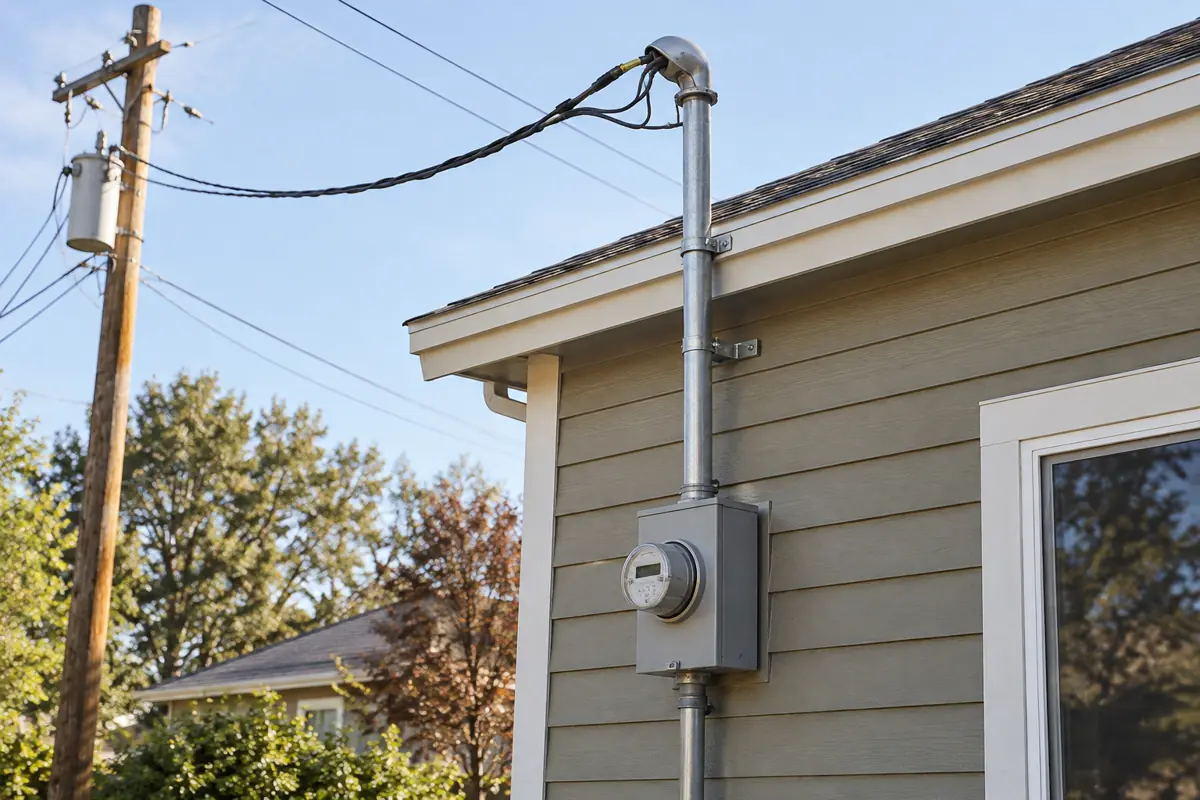
Utility-side work, not the panel, drives the high end
Customer-side panel costs scale predictably, but utility-side charges are threshold-driven: a transformer, pole or underground run can move a job from a few thousand dollars to tens of thousands.
PG&E's own published cost ranges for changing a residential service under 400 A show the spread. For overhead service, 25% of jobs cost less than $3,000, 75% less than $13,000 and 5% more than $40,000. For underground service, 20% cost less than $2,500, 75% less than $10,000 and 5% more than $31,000 (PG&E cost range pages, as saved by SPUR in 2024).
Utility allowances offset only part of this. The 2022 study put PG&E's Rule 16 allowance at $2,154 and SDG&E's at $3,241, and found that customers paid $300 to $16,000 or more above the allowance (PG&E and SDG&E study, 2022). In LBNL's national survey, only 1 of 11 utility respondents reported any allowance for a service rating increase (LBNL, 2026).
A new transformer cost $6,000 to $8,000 at PG&E in 2022. A homeowner alone on a transformer pays 100% of the upgrade, 50% if two homes share it and 0% if three or more do (PG&E and SDG&E study, 2022). A California pilot reported $15,000 to $19,000 for transformer and pole replacement (CalNEXT, 2025).
| Cost driver | Published figure | Geography and year | Source |
|---|---|---|---|
| Utility-side service work passed to the customer | $3,500 median (IQR $1,650 to $7,000), 19 responses | US, 2025 survey | LBNL 2026 |
| PG&E overhead service change under 400 A | 25% under $3,000; 75% under $13,000; 5% over $40,000 | PG&E territory, page saved 2024 | PG&E |
| PG&E underground service change under 400 A | 20% under $2,500; 75% under $10,000; 5% over $31,000 | PG&E territory, page saved 2024 | PG&E |
| Utility allowance toward service upgrade | $2,154 (PG&E); $3,241 (SDG&E) | California, 2022 | PG&E and SDG&E study |
| Utility allowance reported nationally | 1 of 11 utility respondents reported a non-zero allowance ($2,100) | US, 2025 | LBNL 2026 |
| New transformer | $6,000 to $8,000; customer pays 100% if alone on transformer, 50% if shared by two, 0% if three or more | PG&E, 2022 | PG&E and SDG&E study |
| Pole transformer | $3,000 to $5,000 | US, 2025 | LBNL 2025 |
| Transformer and pole replacement | $15,000 to $19,000 | California, 2025 | CalNEXT |
| Permits | $130 to $170 (2022 study); $625 to $1,000 (2025 pilot); medians at or near $100 (2025 survey) | California; US | PG&E study; CalNEXT; LBNL 2026 |
| Electrician time on site | 4 to 15 hours for panel and smart breaker installs, 5 contractors | California pilot, 2025 | CalNEXT |
| Rewiring of hazardous or undersized conductors | $5,000 median, 21 responses | US, 2025 survey | LBNL 2026 |
Figures come from different years and places and should not be added together.
Source: [1][2][4][5][7] Lawrence Berkeley National Laboratory; Lawrence Berkeley National Laboratory; Pacific Gas and Electric Company and San Diego Gas and Electric Company; Pacific Gas and Electric Company; CalNEXT (California investor-owned utility emerging technologies program), prepared by TRC and UC Davis
Building industry estimates, US survey of summer 2025, nominal dollars
Source: Lawrence Berkeley National Laboratory, Understanding the Costs and Barriers of Residential Electrical Panel and Service Upgrades (August 2026)
Time is the other driver. In LBNL's survey, 70% of single-family projects without a service rating increase were completed within 30 days, against 64% of projects with one (LBNL, 2026). The PG&E process typically took 10 to 30 days, with cases up to eight months; SDG&E's documented timeline ran up to 17 weeks (PG&E and SDG&E study, 2022).
Fewer homes may need the work than once assumed. A DOE-funded NREL and LBNL project estimated that 30% of single-family homes have 100 A panels and 49% have 200 A panels (DOE BTO, 2024). LBNL modelling found the share of buildings needing a panel replacement falls from 56% to 44% with the proposed 2026 NEC load-calculation revisions, and to 6% when combined with least-cost appliance choices (LBNL, 2025). See our 2026 NEC adoption tracker.
Permit fees run $72 to $347 in the nine big cities we could check
Applied to the same 200 A job, published fee schedules in 9 of the 20 largest cities give fees from $72.17 to $347.48, a median of $119, or 2.1% to 9.9% of a $3,500 job. The other 11 schedules could not be opened or have no single residential line.
Cities price this permit in four ways: a flat fee by amperage (Seattle, Jacksonville), a flat item fee (San Diego), a fee tied to job value (Phoenix, Philadelphia), or a sum of item fees (New York, San Antonio, Austin). Seattle's 2026 schedule charges $292.00 for a new or altered 150 to 200 A service plus a $55.48 administrative fee (Seattle SDCI). San Diego charges $176.57 for a panel replacement or upgrade up to 200 A (San Diego IB-103).
| Rank | City | Population (July 1, 2025) | Fee basis | Fee for ECW scope | Share of a $3,500 job | How computed or status |
|---|---|---|---|---|---|---|
| 1 | New York, NY | 8,584,629 | Per item (1 RCNY 101-03) | $152.50 | 4.4% | $40 filing + $30 service switch 101 to 200 A + $45 service-entrance conductors over #1/0 to 250 MCM + $37.50 single-phase panel over 20 breakers; DOB NOW collects at least $130 at submission |
| 2 | Los Angeles, CA | 3,869,089 | Not retrieved | Not available | LADBS electrical fee schedule PDF returned HTTP 403 on 2026-10-27 | |
| 3 | Chicago, IL | 2,731,585 | Not retrieved | Not available | Department of Buildings fee excerpts returned HTTP 403 on 2026-10-27 | |
| 4 | Houston, TX | 2,397,315 | Not retrieved | Not available | Houston Permitting Center pages returned HTTP 403 on 2026-10-27 | |
| 5 | Phoenix, AZ | 1,665,481 | Project valuation (Table A) | $231.00 | 6.6% | $195 on first $1,000 + $12 for each additional $1,000 or fraction, at a $3,500 valuation |
| 6 | Philadelphia, PA | 1,574,281 | Estimated electrical cost | $100.00 | 2.9% | $25 for each $1,000 or fraction of estimated electrical cost (minimum $63), at $3,500 |
| 7 | San Antonio, TX | 1,548,422 | Base fee + items + surcharges | $72.17 | 2.1% | ($57.50 base + $3.74 service 0 to 200 A + $5.58 panelboard) x 1.08 for 4% technology and 4% development services fees |
| 8 | San Diego, CA | 1,406,106 | Flat item fee | $176.57 | 5.0% | Panel replace or upgrade up to 200 A, each (IB-103, May 2026) |
| 9 | Dallas, TX | 1,329,491 | Not determined | Not available | Fee documents effective July 1, 2025 list commercial alterations including standalone trade permits (minimum $175) but no residential standalone electrical line | |
| 10 | Fort Worth, TX | 1,028,117 | Minimum fee by number of trades | $119.00 | 3.4% | Residential remodel, one trade, minimum permit fee (Table 1A-1, Ordinance 26-28781, effective 2026-10-01) |
| 11 | Jacksonville, FL | 1,017,689 | Flat fee by amperage | $100.00 | 2.9% | Residential service charge, 151 to 200 A service |
| 12 | Austin, TX | 1,002,632 | Itemized city fees | $85.91 | 2.5% | $73.81 standalone project inspections + $12.10 electric service application processing; Austin Energy lists a separate $200 electric service application fee |
| 13 | San Jose, CA | 989,814 | Not retrieved | Not available | City fee schedule document returned HTTP 403 on 2026-10-27 | |
| 14 | Charlotte, NC | 964,784 | Not retrieved | Not available | Mecklenburg County Code Enforcement fee ordinance page returned HTTP 403 on 2026-10-27 | |
| 15 | Columbus, OH | 938,396 | Not retrieved | Not available | 2026 combined fee schedule PDF returned HTTP 403 or 404 on 2026-10-27 | |
| 16 | Indianapolis, IN | 901,116 | Not retrieved | Not available | Fee schedule page did not load without JavaScript on 2026-10-27 | |
| 17 | San Francisco, CA | 826,079 | Not retrieved | Not available | Table 1A-E PDF and code library returned HTTP 403 on 2026-10-27 | |
| 18 | Seattle, WA | 784,777 | Flat fee by amperage | $347.48 | 9.9% | $292.00 new or altered service 150 to 200 A + $55.48 administrative fee (Table D-15) |
| 19 | Denver, CO | 740,613 | Not retrieved | Not available | Development fees page rejected the request on 2026-10-27 | |
| 20 | Nashville, TN | 721,074 | Not retrieved | Not available | Metro Codes fee schedule PDF returned HTTP 403 on 2026-10-27 |
ECW scope: replace the main panel and upgrade service to 200 A in an existing one-family home, one panel, job valued at $3,500 (the LBNL median). Fees are city building or electrical permit fees only, before utility fees. Cities ranked by Census Vintage 2025 population. Not available means the official schedule could not be opened or has no single residential line.
Source: [24][25][26][27][28][29][30][31][32][33][34][35] New York City Department of Buildings; New York City Department of Buildings; City of Phoenix Planning and Development Department; City of Philadelphia Department of Licenses and Inspections; City of San Antonio Development Services Department; City of San Diego Development Services Department; City of Fort Worth; City of Jacksonville; City of Austin Development Services Department; City of Seattle Department of Construction and Inspections; City of Dallas Planning and Development; U.S. Census Bureau
9 of the 20 largest US cities with a retrievable 2026 schedule; ECW standard scope, $3,500 job
Source: city fee schedules in effect 2026-10-27 (New York, Phoenix, Philadelphia, San Antonio, San Diego, Fort Worth, Jacksonville, Austin, Seattle); ECW calculation
National survey data agree that permits are a small share of the bill. LBNL's 33 building department respondents reported panel replacement permit medians at or near $100, with fees often tied to job value (LBNL, 2026). The 2022 California study found $130 to $170 (PG&E and SDG&E study, 2022). Utility fees are separate: Austin Energy lists a $200 electric service application fee on top of the city's $85.91 (City of Austin).
Fee schedules were read on 2026-10-27. Several big-city building departments (Los Angeles, Chicago, Houston, San Jose, Charlotte, Columbus, Indianapolis, San Francisco, Denver, Nashville) block automated downloads; their rows stay blank until the official schedule can be read.
A $4,000 federal cap covers a typical panel, but few programs are open
The federal HEEHR panel cap of $4,000 equals 109% of the LBNL panel median in 2026 dollars, but on 2026-10-27 California's program was fully reserved and Minnesota, Oregon and Hawaii had not launched.
The statute allows up to $4,000 for an electric load service center (panel) upgrade, $2,500 for wiring and $14,000 in total per household. It covers 100% of cost for households below 80% of area median income and 50% for households between 80% and 150% (42 U.S.C. 18795a). On a $3,663 panel job (the LBNL median in September 2026 dollars), the 50% tier pays $1,832, or 50% of the cost.
DOE Program Notice 26-2, effective May 29, 2026, renamed the program High-Efficiency Electric Home Rebates (HEEHR), removed fuel-switching upgrades and allows only electric-to-electric replacements, with launched programs given three months to comply. North Carolina applied the change from 2026-09-01 (NC DEQ). A panel installed as part of a switch from gas equipment to a heat pump therefore falls outside new reservations.
| Program | Geography | Panel amount | Conditions | Status (as dated) | Source date |
|---|---|---|---|---|---|
| HEEHR (formerly HEAR), federal statute | United States | Up to $4,000 (panel); $2,500 wiring; $14,000 total | 100% of cost below 80% AMI; 50% at 80% to 150% AMI | Run by state energy offices | IRA 2022 |
| DOE Program Notice 26-2 | United States | Caps unchanged | Fuel-switching upgrades removed; electric-to-electric allowed | Effective 2026-05-29; launched programs to comply within three months | 2026-05-29 |
| DOE program page | United States | Up to $14,000 per household | Panels listed as load service center upgrades | Available in select states | 2026-10-27 |
| California HEEHRA (CEC, TECH) | California | Panel listed as eligible equipment | Contractor-delivered | Single-family fully reserved 2026-02-24; multifamily fully reserved 2026-09-01 | 2026-10-27 |
| Energy Saver North Carolina (HEAR) | North Carolina | Not stated on page | No fuel switching from 2026-09-01 | Open, new rules from 2026-09-01 | 2026 |
| Minnesota HEAR | Minnesota | $4,000 (at or below 80% AMI); $2,000 (80% to 150%) | Panel-only projects not eligible | Not launched; no launch date (note of 2026-10-12) | 2026-10-12 |
| Oregon HEAR | Oregon | $4,000 electric load service center | Up to $14,000 per project | No rebates available; contractor enrollment opened 2026-10-12 | 2026-10-27 |
| Hawaii eHale (HEEHR pathway) | Hawaii | Panel and wiring upgrades listed | Pending DOE approval of launch | 2026-10-27 | |
| Colorado HEAR (nonprofit summary) | Colorado | Up to $14,000 per household | Fuel switching ends after 2026-08-01 | $3.4 million left in Region 2 as of 2026-06-29 | 2026-06-29 |
| Washington state HEAR (Climate Commitment Act) | Washington | Panel and wiring upgrades eligible | Via 40 local administrators | $39.3 million awarded | 2026-09-08 |
| SMUD Go Electric | Sacramento, CA | Up to $4,000 (smart panel, subpanel, new circuit) | Gas-to-electric conversion required | Listed on SMUD rebate page | 2026-10-27 |
| Peninsula Clean Energy | San Mateo County, CA | $1,000 panel bonus | Panel 200 A or less after upgrade; with a heat pump rebate | Terms dated 2026-05-18 | 2026-05-18 |
| Federal 25C tax credit | United States | Up to $600 per item (panelboards 200 A or more) | With qualifying energy property | Ended for property placed in service after 2025-12-31 | 2026-10-27 |
Status as stated on each program page on the date shown. HEEHR is the federal program formerly called HEAR.
Source: [9][10][11][12][13][14][16][17][18][19][20][22][23] Legal Information Institute, Cornell Law School (U.S. Code text); U.S. Department of Energy; U.S. Department of Energy, Office of State and Community Energy Programs; TECH Clean California (California Energy Commission HEEHRA program); North Carolina Department of Environmental Quality; Minnesota Department of Commerce; Oregon Department of Energy; Hawaii State Energy Office; Washington State Department of Commerce; Southwest Energy Efficiency Project; Sacramento Municipal Utility District; Peninsula Clean Energy; Internal Revenue Service
Maximum panel amount per program; LBNL median in September 2026 dollars
Source: 42 U.S.C. 18795a; SMUD; Peninsula Clean Energy; IRS; LBNL (2026); ECW calculation
Utility programs are smaller and tied to other upgrades. SMUD lists up to $4,000 in Go Electric rebates for a smart panel, subpanel and new circuits with a gas-to-electric conversion (SMUD). Peninsula Clean Energy pays a $1,000 panel bonus with a heat pump rebate, for panels of 200 A or less (PCE). The federal 25C credit of up to $600 for panelboards of 200 A or more ended for property placed in service after December 31, 2025 (IRS).
Electrician wage cost for a panel installation runs $103 to $719 by state
Using the May 2025 mean electrician wage and the 4 to 15 hours CalNEXT recorded for panel installs, the wage cost of one electrician runs from $102.84 to $719.40 by state. This is a labor-only floor, not a price.
Formula: labor-only wage cost = state mean hourly wage for electricians (SOC 47-2111, BLS OEWS May 2025) x installation hours. Hours come from a 2025 California pilot in which panel and smart breaker installs took 4 to 15 hours, with a helper on most jobs (CalNEXT, 2025). At the US mean of $34.37, the result is $137.48 to $515.55, or 3.9% to 14.7% of the $3,500 LBNL median.
Electrician mean hourly wage (May 2025) x 15 hours; wage only, not a contractor price
Source: BLS OEWS May 2025 (electricians, 47-2111); hours from CalNEXT 2025 pilot; ECW calculation
Show all 52 rows
| State | Mean hourly wage, electricians (May 2025) | Labor-only wage cost at 4 hours | Labor-only wage cost at 15 hours |
|---|---|---|---|
| Oregon | $47.96 | $191.84 | $719.40 |
| Washington | $45.42 | $181.68 | $681.30 |
| Hawaii | $44.65 | $178.60 | $669.75 |
| Illinois | $44.34 | $177.36 | $665.10 |
| Alaska | $43.29 | $173.16 | $649.35 |
| District of Columbia | $42.72 | $170.88 | $640.80 |
| New Jersey | $41.68 | $166.72 | $625.20 |
| California | $41.28 | $165.12 | $619.20 |
| New York | $40.80 | $163.20 | $612.00 |
| Massachusetts | $39.21 | $156.84 | $588.15 |
| Minnesota | $38.86 | $155.44 | $582.90 |
| Connecticut | $37.21 | $148.84 | $558.15 |
| Maine | $37.14 | $148.56 | $557.10 |
| Pennsylvania | $36.43 | $145.72 | $546.45 |
| Nevada | $36.40 | $145.60 | $546.00 |
| Maryland | $36.28 | $145.12 | $544.20 |
| Wyoming | $35.99 | $143.96 | $539.85 |
| Rhode Island | $35.65 | $142.60 | $534.75 |
| Michigan | $35.50 | $142.00 | $532.50 |
| Wisconsin | $35.49 | $141.96 | $532.35 |
| Vermont | $35.27 | $141.08 | $529.05 |
| Missouri | $34.77 | $139.08 | $521.55 |
| Montana | $34.58 | $138.32 | $518.70 |
| Indiana | $34.05 | $136.20 | $510.75 |
| Delaware | $34.02 | $136.08 | $510.30 |
| North Dakota | $33.87 | $135.48 | $508.05 |
| Kansas | $33.27 | $133.08 | $499.05 |
| Ohio | $33.09 | $132.36 | $496.35 |
| Virginia | $32.62 | $130.48 | $489.30 |
| West Virginia | $32.61 | $130.44 | $489.15 |
| Idaho | $32.02 | $128.08 | $480.30 |
| Colorado | $31.88 | $127.52 | $478.20 |
| New Hampshire | $31.63 | $126.52 | $474.45 |
| Utah | $31.39 | $125.56 | $470.85 |
| Arizona | $30.88 | $123.52 | $463.20 |
| Nebraska | $30.75 | $123.00 | $461.25 |
| Tennessee | $30.55 | $122.20 | $458.25 |
| Oklahoma | $30.49 | $121.96 | $457.35 |
| Iowa | $30.38 | $121.52 | $455.70 |
| Louisiana | $29.98 | $119.92 | $449.70 |
| South Dakota | $29.80 | $119.20 | $447.00 |
| Kentucky | $29.52 | $118.08 | $442.80 |
| Georgia | $29.37 | $117.48 | $440.55 |
| New Mexico | $28.66 | $114.64 | $429.90 |
| Texas | $28.50 | $114.00 | $427.50 |
| South Carolina | $28.38 | $113.52 | $425.70 |
| Mississippi | $27.88 | $111.52 | $418.20 |
| Florida | $27.72 | $110.88 | $415.80 |
| Alabama | $27.65 | $110.60 | $414.75 |
| North Carolina | $27.33 | $109.32 | $409.95 |
| Arkansas | $25.71 | $102.84 | $385.65 |
| United States | $34.37 | $137.48 | $515.55 |
Wage cost of one electrician only. It excludes the helper CalNEXT reported on most jobs, payroll taxes, benefits, overhead, profit, materials and permits, so it is far below a contractor's price. Hours: CalNEXT 2025 pilot, panel and smart breaker installs, five contractors.
Source: [36][7] U.S. Bureau of Labor Statistics; CalNEXT (California investor-owned utility emerging technologies program), prepared by TRC and UC Davis
Oregon has the highest mean wage at $47.96 an hour and Arkansas the lowest at $25.71, a ratio of 1.87. The gap between this wage floor and the $3,500 median reflects the helper, benefits, overhead, permits, the panel itself and copper conductors (see the copper wire price index). Median wages by state are on our electrician salary page, and other job costs are in our pricing section.
How the benchmark is built
Benchmark: median of published central figures, in 2026 dollars
FormulaEach figure x (CPI-U Sep 2026 / CPI-U annual average of its price year); median of the six results
Inputs: fact rows 1, 6, 42, 45, 66, 67, 98 to 101; derived d1 to d11 (fact sheet rows)
Result: $2,962 (nominal median $2,690); range $2,072 to $3,663
A typical single-family panel job in public data costs about $3,000 in today's dollars before any utility-side work.
Limitations: Six figures from four studies; scopes differ (two are added costs on heat pump jobs); LBNL figures are estimates, not invoices.
Permit fee for a 200 A job in the 20 largest cities
FormulaEach city's published 2026 fee schedule applied to one standard scope ($3,500 job, 200 A service, one panel)
Inputs: fact rows 173 to 181; tables t3 (fact sheet rows)
Result: $72.17 to $347.48 in 9 cities; median $119; 2.1% to 9.9% of the job
Permits rarely decide the price; utility charges do.
Limitations: 11 of 20 cities not available; item counts and conductor sizes assumed for itemized schedules.
Rebate cap as a share of the median cost
FormulaProgram maximum / LBNL panel median in September 2026 dollars ($3,663) x 100
Inputs: fact rows 78, 82, 94, 95; derived d4, d12 to d17 (fact sheet rows)
Result: HEEHR $4,000: 109% (135% of the benchmark); HEEHR 50% tier: $1,832, 50%; PCE $1,000: 27%; expired 25C: 16%
Where it is open, the federal cap fully covers a typical panel for lower-income households.
Limitations: Few state programs were taking new panel reservations on 2026-10-27.
Labor-only wage cost by state
FormulaBLS OEWS May 2025 mean hourly wage (47-2111) x 4 hours and x 15 hours
Inputs: fact rows 69, 70, 96, 102 to 152 (fact sheet rows)
Result: US $137.48 to $515.55; $102.84 (Arkansas) to $719.40 (Oregon)
One electrician's wages are 3.9% to 14.7% of the $3,500 median.
Limitations: Wage only; hours from five California pilot installs of smart panels and breakers; excludes helper, benefits, overhead and profit.
Where contractors differ
- A national LBNL survey of summer 2025 put the median single-family main panel replacement at $3,500 (34 responses, United States), with a $2,100 to $5,000 interquartile range.[1]
- The median of six published central figures (2020 to 2025, United States and California) is $2,962 in September 2026 dollars, or $2,690 before inflation adjustment.[1][3][4][6][37]
- Utility-side costs passed to single-family customers for a service rating increase had a $3,500 median and a $5,040 mean (19 responses, United States, 2025).[1]
- Electricians in the PG&E and SDG&E territories reported customer-owned panel upgrades averaging $2,780, within $2,000 to $4,500 (California, study published 2022).[4]
- PG&E's published ranges for changing an overhead service under 400 A: 25% of jobs under $3,000, 75% under $13,000, 5% over $40,000 (PG&E territory, as saved in 2024).[5]
- Only 1 of 11 utility respondents in the 2025 LBNL survey reported any allowance toward a service rating increase ($2,100); the rest reported none (United States).[1]
- Of TECH Clean California single-family installs, 4% of heat pump HVAC and 9% of heat pump water heater jobs needed a panel upgrade, adding $2,600 and $1,800 on average (Southern California, 2022 installs).[6]
- City permit fees for a 200 A service and panel replacement ran from $72.17 (San Antonio) to $347.48 (Seattle) in 9 of the 20 largest cities, a $119 median (schedules in effect October 2026).[28][33][24][26][29]
- The federal HEEHR rebate caps a panel upgrade at $4,000 within a $14,000 household total, covering 100% of cost below 80% of area median income and 50% from 80% to 150% (United States, statute).[9]
- DOE Program Notice 26-2, effective May 29, 2026, removed fuel-switching upgrades from the HEEHR program nationwide.[10]
- California's HEEHRA single-family rebates were fully reserved statewide on February 24, 2026, and multifamily rebates on September 1, 2026.[12]
- The labor-only wage cost of a 4 to 15 hour panel installation ranges from $102.84 (Arkansas, 4 hours) to $719.40 (Oregon, 15 hours), using May 2025 mean electrician wages.[36][7]
- LBNL modelling found 56% of single-family buildings would need a panel replacement under business-as-usual electrification and the existing NEC, falling to 44% with the proposed 2026 NEC revisions (United States, 2025).[2]
In short
- The typical single-family electrical panel upgrade cost in published program and lab data is $2,962 in September 2026 dollars (median of six figures).
- The newest and largest sample, LBNL's 2025 survey, gives a $3,500 median for a main panel replacement and $2,800 for customer-side service equipment.
- Utility-side work is the wild card: PG&E data show 5% of overhead service changes above $40,000.
- Permits are a small line: $72.17 to $347.48 in nine large cities, 2.1% to 9.9% of a $3,500 job.
- The $4,000 federal HEEHR panel cap equals 109% of the LBNL median in 2026 dollars, but key state programs were closed or not launched in October 2026.
- Electrician wage cost alone for a 4 to 15 hour job is $137.48 to $515.55 at the US mean wage.
- The public record is thin: four studies with central values, small samples, and no national invoice dataset.
What people search for
How much does it cost to upgrade an electrical panel to 200 amps?
For a single-family home, LBNL's 2025 survey gives a $2,800 median for customer-side service equipment and a $3,500 median for a main panel replacement. Where the utility must change the service drop or transformer, LBNL found a further $3,500 median in utility-side charges, and PG&E data show 5% of overhead jobs above $40,000.
How much does it cost to replace an electrical panel?
The LBNL median for a single-family main panel replacement is $3,500 (34 responses, 2025), with a mean of $3,931. The median of six published figures is $2,962 in September 2026 dollars.
Do I need a permit to replace an electrical panel?
Every one of the nine big-city fee schedules we read charges a permit fee for service or panel work, from $72.17 to $347.48 for a 200 A job. In the process documented for PG&E, the contractor obtains the permit from the local building department and schedules the utility disconnect.
Are there rebates for electrical panel upgrades?
The federal HEEHR program allows up to $4,000 for a panel, but only through state programs, only with another eligible electric upgrade in states such as Minnesota, and since May 29, 2026 not for gas-to-electric switches. SMUD offers up to $4,000 and Peninsula Clean Energy $1,000 with heat pump projects. The $600 federal 25C credit ended in 2025.
How long does a panel upgrade take?
On site, 4 to 15 hours for the panel and smart breaker installs in a 2025 California pilot. From permit to completion, 70% of single-family jobs without a service increase finished within 30 days in LBNL's survey, and 64% with one. PG&E's process typically took 10 to 30 days, with some cases up to eight months.
Common questions
What is the average electrical panel upgrade cost?
LBNL's 2025 survey reported a $3,931 mean and a $3,500 median for a single-family main panel replacement. The median of six published figures is $2,962 in September 2026 dollars.
Why do panel upgrade quotes vary so much?
The panel itself scales predictably; utility work does not. PG&E's ranges for an overhead service change run from under $3,000 for 25% of jobs to over $40,000 for 5%.
Does the utility pay for a service upgrade?
Partly, in some territories. PG&E's allowance was $2,154 and SDG&E's $3,241 in 2022, but only 1 of 11 utility respondents in LBNL's 2025 survey reported any allowance.
Who pays for a new transformer?
At PG&E in 2022, a homeowner alone on a transformer paid 100% of a $6,000 to $8,000 replacement, 50% if two homes shared it and 0% if three or more did.
How much is the electrical permit for a panel upgrade?
In nine of the 20 largest cities, $72.17 (San Antonio) to $347.48 (Seattle) for a 200 A job; LBNL's national survey found panel permit medians at or near $100.
How much is the HEEHR (HEAR) rebate for an electrical panel?
Up to $4,000, within a $14,000 household total. It covers 100% of cost below 80% of area median income and 50% from 80% to 150%.
Can I get a rebate for a panel upgrade alone?
Usually not. Minnesota states a panel-only project is not eligible, and SMUD and Peninsula Clean Energy pay panel amounts only with a qualifying heat pump project.
Is there still a tax credit for an electrical panel?
No. The federal 25C credit of up to $600 for panelboards of 200 A or more ended for property placed in service after December 31, 2025, per the IRS.
How many homes have a 100 amp panel?
A DOE-funded NREL and LBNL project estimated 30% of US single-family homes have 100 A panels and 49% have 200 A panels (2024).
What does an electrician earn per hour for panel work?
BLS reports a US mean wage of $34.37 an hour for electricians in May 2025, from $25.71 in Arkansas to $47.96 in Oregon; contractor billing rates are higher.
Get the data
Every table in this report is available as a CSV under CC BY 4.0. The fact sheet lists each value with its source URL and access date.
- derived_metrics.csv (CSV)
- fact_sheet.csv (CSV)
- The cost record: every program, lab and utility figure we found for panel and service upgrades (CSV)
- Six central figures adjusted to September 2026 dollars (CSV)
- Permit fees for a 200 A residential service and panel replacement in the 20 largest US cities (CSV)
- Panel rebates and credits: amounts and status, dated (CSV)
- Labor-only wage cost of a panel installation by state (electrician mean wage x 4 to 15 hours) (CSV)
- What drives the price: published figures for each cost driver (CSV)
Cite this report
The figures to cite first
- Single-family main panel replacement: $3,500 median, $3,931 mean, 34 responses (LBNL, US, summer 2025 survey).[1]
- Benchmark of six published figures: $2,962 in September 2026 dollars (ECW calculation, CPI-U adjusted).[1][4][6][3][37]
- Federal HEEHR panel cap $4,000; fuel-switching removed from May 29, 2026 (42 U.S.C. 18795a; DOE PN 26-2).[9][10]
Quotable figures
- The median single-family main panel replacement cost $3,500 in a 2025 national LBNL survey of 34 contractor and engineer estimates.[1]
- Six published program and lab figures put the typical panel or service upgrade at $2,962 in September 2026 dollars.[1][3][4][6][37]
- PG&E data show 5% of overhead service changes under 400 A cost more than $40,000.[5]
- Only 1 of 11 utility respondents in a 2025 national survey reported any allowance toward a service upgrade.[1]
- Permit fees for a 200 A panel job ran from $72.17 in San Antonio to $347.48 in Seattle in October 2026.[28][33]
- The federal HEEHR panel rebate cap of $4,000 equals 109% of the LBNL median panel cost in 2026 dollars.[9][1]
Summary for editors
A typical single-family electrical panel upgrade costs about $2,962 in September 2026 dollars, according to an Electrical Contractors and Wiring Data Desk benchmark built only from national lab, utility program and government figures. The benchmark is the median of six central values published from 2020 to 2025. The largest sample, a 2025 Lawrence Berkeley National Laboratory survey, put the median main panel replacement at $3,500. Utility-side charges are the main source of variation: PG&E's own ranges show 5% of overhead service changes above $40,000, and only 1 of 11 utilities surveyed by LBNL reported any customer allowance. City permits are minor, at $72.17 to $347.48 in nine of the 20 largest cities. The federal HEEHR rebate caps panel help at $4,000, enough to cover a typical job, but in October 2026 California's program was fully reserved and Minnesota, Oregon and Hawaii had not launched. The analysis notes that the public cost record remains thin.
Headlines the data supports
- A typical home panel upgrade costs about $2,962, public data show
- Berkeley Lab survey: median panel replacement is $3,500
- Utility work, not the panel, can push service upgrades past $40,000
- Permit fees for a panel swap range from $72 to $347 in big US cities
- A $4,000 federal panel rebate exists, but few states are paying it
Citation
Electrical Contractors and Wiring. (2026). Electrical panel upgrade cost: what lab, utility and program data show in 2026. Retrieved from https://electricalcontractorsandwiring.com/data/electrical-panel-upgrade-cost/
Reuse
Data and tables are licensed CC BY 4.0. Attribution: “Source: Electrical Contractors and Wiring, Electrical panel upgrade cost: what lab, utility and program data show in 2026” with a link to this page.
How we built this report
Selection: a cost figure was included in the record (table t1) only if a government agency, national laboratory, utility program or nonprofit study published it with a stated scope and year. Six central values (medians, averages or a cost-database estimate) for single-family panel or customer-side service work with a known price year form the benchmark.
Exclusions: LBNL's database average of $1,993 (two projects) and the South Coast AQMD's $3,000 planning assumption are shown but not used in the benchmark; ranges without a central value are shown only in t1. Vendor and marketplace ranges (for example Fixr, updated January 31, 2025, at $1,500 to $4,500) are Tier 3 context and appear in excluded.md, not in any headline.
Inflation: each figure is multiplied by CPI-U for September 2026 (336.940) divided by the CPI-U annual average of its price year (2025: 321.943; 2022: 292.655; 2020: 258.811), from the BLS flat file. The 2022 PG&E and SDG&E study is treated as 2022 prices and RSMeans 2020 as 2020 prices.
Permits: the 20 largest cities come from the Census Vintage 2025 incorporated place estimates. Each city's official 2026 schedule was applied to one scope: replace the main panel and upgrade to 200 A service in an existing one-family home, one panel, valued at $3,500. For New York ECW assumed one service switch, one set of conductors over #1/0 to 250 MCM and one single-phase panel with more than 20 breakers. Eleven cities are marked not available because the official schedule blocked automated access or lacked a residential line; no fee was estimated for them.
Labor: labor-only wage cost = BLS OEWS May 2025 state mean hourly wage for electricians x 4 and x 15 hours. The hours come from five contractor-reported panel and smart breaker installs in a CalNEXT pilot (2025); no national source of panel installation hours was found. The estimate is a wage floor, not a price, and medians by state are on our salary page.
Conflicts: where sources disagree, both figures are shown with their scope (for example, permit costs of $130 to $170 in the 2022 California study against $625 to $1,000 in the 2025 pilot). LBNL figures are self-reported estimates; respondents were concentrated on the West Coast and East Coast.
Rebate status was read from each program page on 2026-10-27 and is dated in table t4. Minnesota's page blocked scripted downloads and was read through a fetch tool; the extraction is saved in raw/. Last updated 2026-10-27.
This report presents published data with its limitations. It is not legal, financial or investment advice.
Sources by tier
Tier 1: primary and official sources (34)
- [1] Lawrence Berkeley National Laboratory. Understanding the Costs and Barriers of Residential Electrical Panel and Service Upgrades (Casquero-Modrego, Venkatraman, Gul, Less, Walker). National survey, summer 2025; published August 2026. Accessed 2026-10-27.
- [2] Lawrence Berkeley National Laboratory. Electric Panel Capacity Constraints (Walker and Less, NESCAUM presentation). August 2025. Accessed 2026-10-27.
- [3] Lawrence Berkeley National Laboratory. The Cost of Decarbonization and Energy Upgrade Retrofits for US Homes (Less, Walker, Casquero-Modrego, Rainer). Project database to 2021; RSMeans 2020 cost data. Accessed 2026-10-27.
- [6] South Coast Air Quality Management District. PAR 1111 and 1121 Working Group Meeting #2 (panel upgrade costs from TECH Clean California data). TECH installs, mostly 2022; presented November 2023. Accessed 2026-10-27.
- [8] U.S. Department of Energy, Building Technologies Office. BTO Peer Review 2024: Solutions for Electrical Panel Constraints (NREL and LBNL). 2024. Accessed 2026-10-27.
- [9] Legal Information Institute, Cornell Law School (U.S. Code text). 42 U.S. Code 18795a, High-efficiency electric home rebate program. Statute as enacted 2022. Accessed 2026-10-27.
- [10] U.S. Department of Energy. Home Energy Rebates Program Notice 26-2, HEEHR Program for States and Territories. Effective May 29, 2026. Accessed 2026-10-27.
- [11] U.S. Department of Energy, Office of State and Community Energy Programs. Home Energy Rebate Programs. Page as of 2026-10-27. Accessed 2026-10-27.
- [12] TECH Clean California (California Energy Commission HEEHRA program). HEEHRA Rebates. Status as of 2026-10-27. Accessed 2026-10-27.
- [13] North Carolina Department of Environmental Quality. Energy Saver North Carolina: Program Changes. 2026. Accessed 2026-10-27.
- [14] Minnesota Department of Commerce. Home Electrification and Appliance Rebates (HEAR) program page. Status note dated 2026-10-12. Accessed 2026-10-27.
- [15] Oregon Department of Energy. Home Energy Rebates. Status as of 2026-10-27. Accessed 2026-10-27.
- [16] Oregon Department of Energy. Oregon HEAR program. Status as of 2026-10-27. Accessed 2026-10-27.
- [17] Hawaii State Energy Office. eHale Energy Saver: Hawaii's Home Energy Rebate Program. Status as of 2026-10-27. Accessed 2026-10-27.
- [18] Washington State Department of Commerce. State Home Electrification and Appliance Rebates (HEAR) Program. Page updated September 8, 2026. Accessed 2026-10-27.
- [20] Sacramento Municipal Utility District. Heating and cooling rebates. Page as of 2026-10-27. Accessed 2026-10-27.
- [21] Sacramento Municipal Utility District. SMUD boosts rebates for heat pumps (news release). February 18, 2026. Accessed 2026-10-27.
- [22] Peninsula Clean Energy. Home Upgrade Rebates Terms and Conditions (May 18, 2026). May 18, 2026. Accessed 2026-10-27.
- [23] Internal Revenue Service. Energy Efficient Home Improvement Credit. Credit for 2023 to 2025. Accessed 2026-10-27.
- [24] New York City Department of Buildings. 1 RCNY 101-03, Fees payable to the Department of Buildings. Rule in effect 2026. Accessed 2026-10-27.
- [25] New York City Department of Buildings. DOB NOW: Build Electrical Updates, Summer 2026 Release (updated May 2026). May 2026. Accessed 2026-10-27.
- [26] City of Phoenix Planning and Development Department. PDD Fee Schedule, approved 12/17/2025 per Ordinance G-7465 (effective 1/20/2026). Effective 2026-01-20. Accessed 2026-10-27.
- [27] City of Philadelphia Department of Licenses and Inspections. PG_012_INF Construction Permit Fees (effective January 1, 2025, rev. 2.2026). Effective 2025-01-01, revised February 2026. Accessed 2026-10-27.
- [28] City of San Antonio Development Services Department. FY 2027 Development Fee Schedule (revised October 2026). FY 2027. Accessed 2026-10-27.
- [29] City of San Diego Development Services Department. Information Bulletin 103: Fee Schedule for Mechanical, Electrical, Plumbing/Gas Permits. Version of May 2026. Accessed 2026-10-27.
- [30] City of Fort Worth. Ordinance No. 26-28781, schedule of fees (effective October 1, 2026). Effective 2026-10-01. Accessed 2026-10-27.
- [31] City of Jacksonville. City Fees: Electrical Permit Fees, Section 320.409. Page as of 2026-10-27. Accessed 2026-10-27.
- [32] City of Austin Development Services Department. Residential Building Plan Review and Inspection Permit Fees (updated 10/14/2026, effective 10/01/2026). FY 2026-27. Accessed 2026-10-27.
- [33] City of Seattle Department of Construction and Inspections. 2026 Fee Subtitle, Table D-15 Electrical Permit Fees (When Plans Are Not Required). 2026. Accessed 2026-10-27.
- [34] City of Dallas Planning and Development. Permit Fee Schedule and Planning and Development Fee Changes (effective July 1, 2025). Effective 2025-07-01. Accessed 2026-10-27.
- [35] U.S. Census Bureau. City and Town Population Totals: 2020 to 2025 (SUB-EST2025). July 1, 2025 estimates. Accessed 2026-10-27.
- [36] U.S. Bureau of Labor Statistics. Occupational Employment and Wage Statistics, May 2025 state and national estimates, Electricians (47-2111). May 2025. Accessed 2026-10-27.
- [37] U.S. Bureau of Labor Statistics. Consumer Price Index for All Urban Consumers (CUUR0000SA0), flat file cu.data.1.AllItems. Annual averages 2020 to 2025; September 2026. Accessed 2026-10-27.
- [39] TECH Clean California (California Energy Commission HEEHRA program). HEEHRA Rebates for Single Family Homes in Central and Southern Regions Fully Reserved as of January 7, 2026. January 8, 2026. Accessed 2026-10-27.
Tier 2: trade bodies, market research, company data (5)
- [4] Pacific Gas and Electric Company and San Diego Gas and Electric Company. Service Upgrades for Electrification Retrofits Study Final Report (CALMAC PG&E0467.01, NV5 and Redwood Energy). Surveys and interviews, published May 27, 2022. Accessed 2026-10-27.
- [5] Pacific Gas and Electric Company. Building and Renovation Services, Project Cost Range: modify overhead and underground electric service under 400 amps (PG&E pages as saved by SPUR, accessed by SPUR March 7, 2024). Historical averages, as published by PG&E in 2024. Accessed 2026-10-27.
- [7] CalNEXT (California investor-owned utility emerging technologies program), prepared by TRC and UC Davis. Electrification Enablement via Load-Balancing Solutions Focused Pilot, Final Report ET24SWE0063. Pilot installations, report dated December 16, 2025. Accessed 2026-10-27.
- [19] Southwest Energy Efficiency Project. Colorado Home Rebates End August 1st. June 29, 2026. Accessed 2026-10-27.
- [38] SPUR. Solving the Panel Puzzle (policy brief). May 2024. Accessed 2026-10-27.