EV Charger Installation Cost at Home: Published Level 2 Figures, the Electrician's Share and Rebates by State, 2026
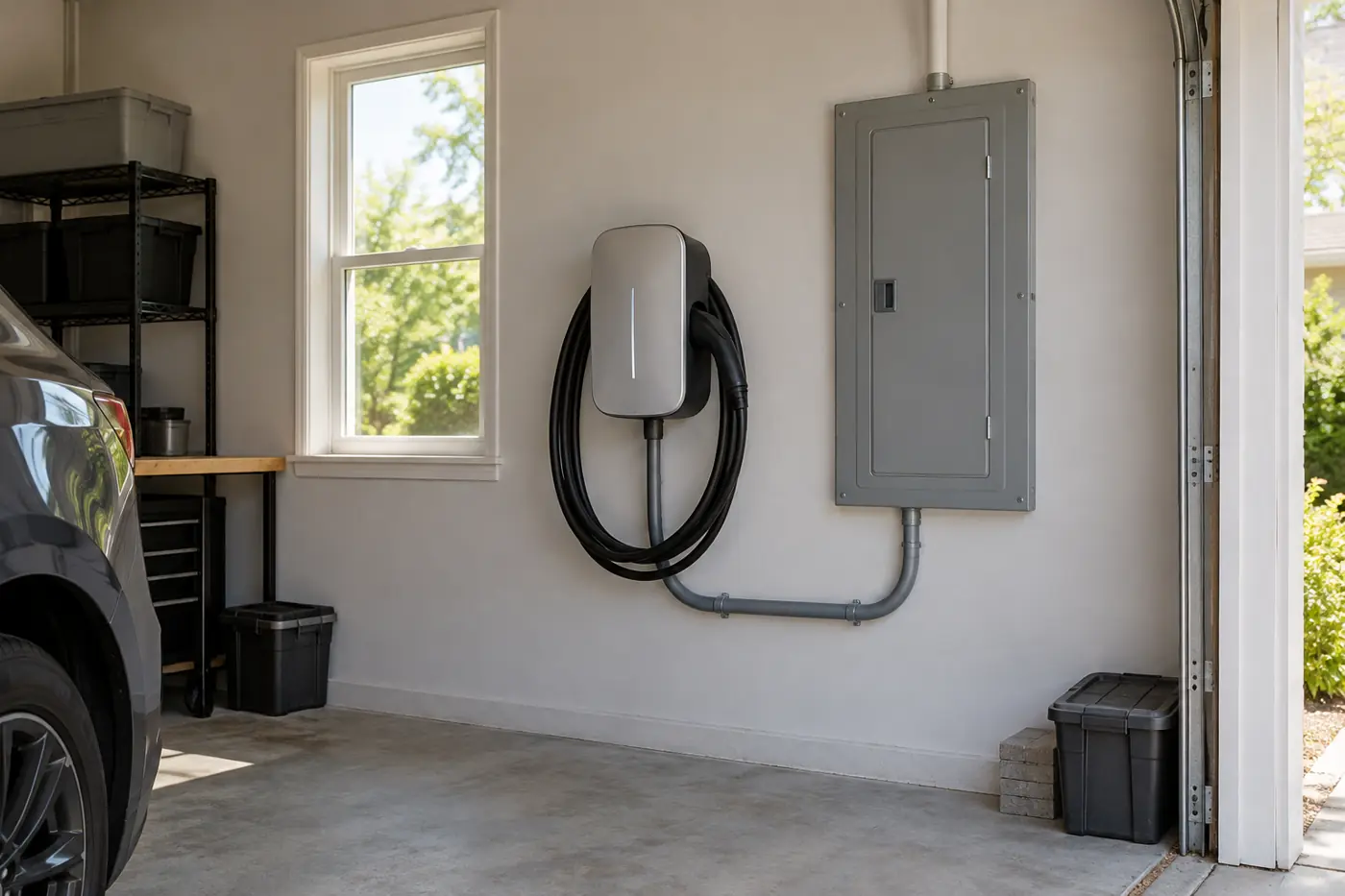
- Data
- Idaho National Laboratory installation records (2015, 2022), NREL 2023 cost assumptions, ICCT 2019, SMUD and City of Santa Barbara program data, EPA 2026 guidance, BLS CPI-U and OEWS May 2025, DOE AFDC incentive listings
- Period
- Installations 2011 to 2026; wages May 2025; rebates and IRS status checked 2026-10-27
- Release used
- 2026-10-27
- Next release
- OEWS May 2026 estimates expected spring 2027; rebate statuses are rechecked when this page is updated
- Geography
- United States; state tables for 50 states and DC
- Sources
- 42 (29 official)
EV charger installation cost for a home Level 2 charger: the median of six published lab, government and utility figures is $1,860 in 2026 dollars, and electrical work is a median 62.2% of it. The federal 30C credit ended for chargers placed in service after June 30, 2026; 21 verified rebates have a median of $500.
EV charger installation cost: six published figures put the median at $1,860 in 2026 dollars
Program, laboratory and government figures for a home Level 2 charger cluster between $1,746 and $2,072 once converted to 2026 dollars. The City of Santa Barbara median of $2,910 is higher because its 13 jobs include panel replacements.
This report uses only figures with a stated scope and year from national laboratories, federal agencies, nonprofits and utility or city programs. The most recent is SMUD: its Charge@Home contractor-network jobs in the 12 months to October 2026 had a median of $1,746 for a charger plus circuit. EPA guidance updated May 7, 2026 gives $400 to $1,000 for equipment and $300 to $2,000 for installation.
Older figures carry larger samples. INL 2022 analysed 4,800+ residential installation records from July 2018 to May 2022: the median installation price was $1,098 and a basic Level 2 wallmount charger had a median list price of $549, a combined $1,647, or $1,870 in 2026 dollars. ICCT 2019 averaged published studies to $1,400 (2019 dollars) for a Level 2 charger upgrade in a detached house, which is $1,819 in 2026 dollars. NREL 2023 assumes $400 to $1,200 for hardware and $500 to $1,700 for installation per port, a $1,900 midpoint.
| Source | Data period | Scope | Hardware | Installation | Total as published | Total in 2026 dollars | Basis |
|---|---|---|---|---|---|---|---|
| INL, EV Project (2015) | 2011 to 2013 | Single-family; installation incl. permit and service upgrades; charger supplied free | Not included | $1,200 median ($1,354 mean) | Not published | Not computed | 8,300+ installations managed in 13 markets |
| ICCT working paper (2019) | 2019 dollars | Detached house, Level 2 charger upgrade | $720 implied | $680 (wiring and 240-volt outlet) | $1,400 | $1,819 | Average across published studies |
| USDOT ITS Costs Database (2020) | 2019 data | Single-family house, Level 2 outlet and charger | Not split | Not split | $1,400 | Same figure as ICCT, not counted twice | Federal database entry citing ICCT |
| INL breakdown report (2022) | Jul 2018 to May 2022 | Single-family installer records | $549 median basic list price | $1,098 median ($1,310 mean) | $1,647 composite | $1,870 | 4,800+ installation records |
| NREL, 2030 National Charging Network (2023) | Assumptions from 2019 to 2022 studies | Per residential Level 2 port | $400 to $1,200 | $500 to $1,700 | $1,900 midpoint | $2,072 | Low and high assumptions |
| Rocky Mountain Institute (2019) | 2019 | Charger hardware only | $380 to $689 | Not covered | Not published | Not computed | Product price survey |
| City of Santa Barbara (2025) | As of August 2025 | Charger plus electrical work, completed projects | Not split | Not split | $2,820 median ($4,093 mean) | $2,910 | 13 projects; pricier ones included panel upgrades |
| SMUD Charge@Home (2026) | 12 months to October 2026 | Program contractor network jobs | Not split | $1,100 median (circuit only) | $1,746 median (charger plus circuit) | $1,746 | Program projects |
| EPA Green Vehicle Guide (2026) | Updated May 7, 2026 | Consumer guidance ranges | $400 to $1,000 | $300 to $2,000 | $1,850 midpoint | $1,850 | Published ranges |
| Dominion Energy Residential Charger Program (2026) | 2026 | Bundled price incl. maintenance and five-year warranty | Included | Included | $1,835.96 upfront | Excluded from median | Program price, not a market sample |
Installation-only figures exclude the charger. Totals in 2026 dollars use CPI-U (2026 base = January to September average). Vendor and marketplace averages are excluded by design.
Source: [5][8][9][7][10][16][18][17][11][25] Idaho National Laboratory, U.S. Department of Energy; International Council on Clean Transportation; U.S. Department of Transportation, ITS Joint Program Office; Idaho National Laboratory, U.S. Department of Energy; National Renewable Energy Laboratory for the Joint Office of Energy and Transportation; Rocky Mountain Institute; City of Santa Barbara; Sacramento Municipal Utility District; U.S. Environmental Protection Agency; Dominion Energy
Hardware plus installation; six program, lab and government figures, 2019 to 2026
Source: ICCT 2019; INL 2022; NREL 2023; City of Santa Barbara 2025; SMUD 2026; EPA 2026; CPI-U from BLS
The City of Santa Barbara published 13 completed residential projects (updated August 2025) ranging from $686.70 to $9,800, with a mean of $4,093.39 and a median of $2,820. The city notes that the more expensive projects generally included replacing or upgrading the electrical service panel. The Dominion Energy Residential Charger Program in Virginia lists an upfront price of $1,835.96 that bundles the charger, installation, permitting and a five-year warranty; it is shown in the table but excluded from the median because it includes maintenance.
EV charger rebates by state: 21 verified programs have a median of $500
Utility programs, not states, carry most residential charger rebates. 45 states and DC have at least one AFDC-listed utility rebate or a state or DC program; five states have neither.
The AFDC Utility Incentives page listed 114 utilities with a residential Level 2 charger purchase rebate, 74 with a Level 2 installation rebate and 17 with a make-ready or pre-wiring rebate on October 27, 2026, 162 utilities in all. California had the most (28), followed by Massachusetts (14) and Minnesota (12). AFDC does not publish amounts or funding status, so this report opened program pages and recorded the amount shown.
| State | Administrator | Program | Type | Standard maximum | Terms | Adders | Status 2026-10-27 | Evidence |
|---|---|---|---|---|---|---|---|---|
| Alaska | Chugach Electric Association | Residential EV Charging Program | Utility bill credit | $200 | Level 2 (208 to 240 volt) charger; up to 2 per account | None listed | Listed as current on program page | Program page |
| California | Burbank Water and Power | Residential EV Charging Stations Rebate | Municipal utility rebate | $500 | Smart charger $500; standard charger $200; up to two stations | DAC smart charger $600; panel upgrade adds $750 ($900 DAC); up to $1,500 in total | Listed as available on program page | Program page |
| California | Los Angeles Department of Water and Power | Residential EV Charger Rebate | Municipal utility rebate | $1,000 | Qualified residential EV charger | Lifeline or EZ-SAVE customers add $500; $250 for a separate EV meter | Listed as available on program page | Program page |
| California | Sacramento Municipal Utility District | Charge@Home | Municipal utility incentive | $850 | Toward charging equipment and installation | None listed on FAQ | Listed as available on program page | Program page |
| California | South Coast AQMD and MSRC | Residential EV Charging Incentive Pilot Program | Regional air district rebate | $500 | Qualified residential Level 2 charger; low-income residents only | Low-income only | AFDC record (state record reviewed December 2025); program page not opened | AFDC record |
| California | El Dorado County AQMD | Residential EV and EV Charger Rebates | County air district rebate | $300 | Purchase of a Level 2 EV charger; full-time county residents | None listed | AFDC record (state record reviewed December 2025); program page not opened | AFDC record |
| District of Columbia | DC Office of Tax and Revenue | AFV Conversion and Infrastructure Tax Credit | Tax credit | $1,000 | 50% of equipment and labor per residential charging station | None | AFDC record: credit expires 2026-12-31 | AFDC record |
| Georgia | Carroll EMC | Home charger rebate | Cooperative rebate | $250 | New NRTL or UL listed Level 2 station at residence; apply within 45 days | None listed | Listed as available on program page | Program page |
| Georgia | Coweta-Fayette EMC | EV Rebate | Cooperative rebate | $100 | Installation of a Level 2 (240 volt) NRTL or UL approved station | None listed | Listed on program page | Program page |
| Maine | Efficiency Maine | Off-Peak Charger Incentives | State program discount | $400 | $200 instant discount plus $200 set-up bonus on Emporia off-peak chargers | None listed | Listed as available on program page | Program page |
| Maryland | Maryland Energy Administration | Residential EVSE Rebate Program (FY27) | State rebate | $700 | 50% of eligible costs, Level 2 only, one per individual | None | Open: 33.72% of $1,500,000 budget reserved as of 2026-10-19 | Program page |
| Michigan | Consumers Energy | Level 2 charger installation rebate | Utility rebate | $500 | Installation of a qualified Level 2 charger | $120 per EV for off-peak charging (separate) | Listed as available on program page | Program page |
| Michigan | Lansing Board of Water and Light | Residential EV Charging Program | Municipal utility rebate | $1,000 | Second meter installation rebate up to $1,000; off-peak savers rebate up to $500 | None listed | Listed on program page | Program page |
| Michigan | Holland Board of Public Works | Level 2 EV Charger Rebate | Municipal utility rebate | $300 | Level 2 charger | Panel upgrade $1,000; load management device $300 | Listed on program page | Program page |
| Minnesota | Otter Tail Power | EV charging stations and rate | Utility rebate | $500 | Level 2 charger on an off-peak rate | None listed | Listed on program page | Program page |
| Minnesota | City of Buffalo (Buffalo Municipal Utilities) | Home EV charger rebate | Municipal utility bill credit | $500 | Home-installed 240-volt charger | None listed | Listed on program page | Program page |
| New Jersey | New Jersey Board of Public Utilities | Charge Up NJ In-Home EV Charger Incentive | State rebate | $250 | Qualifying Level 2 charger | None | Listed on program page; Clean Fleet program paused 2026-07-24 (not residential) | Program page |
| Texas | Guadalupe Valley Electric Cooperative | Home-charger installation offer | Cooperative rebate | $600 | Lesser of 50% or $600 off home-charger installation | None listed | Listed on program page | Program page |
| Vermont | Vermont Electric Cooperative | Level II charger incentive | Cooperative incentive | $250 | Member-purchased Level II charger with peak-avoiding schedule or enrolment | $50 upfront plus $8 a month for event enrolment | Listed on program page | Program page |
| Washington | Tacoma Public Utilities | EV charging bill credits | Municipal utility bill credit | $600 | $400 per item (charger, splitter, electrical work or 240-volt outlet); $600 maximum combined | None listed | Listed as current on program page | Program page |
| Washington | Clark Public Utilities | Electric vehicle program | Public utility rebate | $500 | Energy Star connected Level II charger; $100 for other Level II chargers; two per household | None listed | Listed on program page | Program page |
Standard maximum = largest charger or installation incentive for one charger for a standard residential customer, excluding panel and income adders. A purposive sample of 21 programs, not a census.
Source: [15][17][22][23][24][26][27][28][29][30][31][32][33][34][35][36][37][38][39] U.S. Department of Energy, Alternative Fuels Data Center; Sacramento Municipal Utility District; Maryland Energy Administration; New Jersey Board of Public Utilities; Efficiency Maine; Burbank Water and Power; Los Angeles Department of Water and Power; Guadalupe Valley Electric Cooperative; Consumers Energy; Lansing Board of Water and Light; Holland Board of Public Works; Otter Tail Power Company; City of Buffalo, Minnesota; Tacoma Public Utilities; Clark Public Utilities; Vermont Electric Cooperative; Carroll Electric Membership Corporation; Coweta-Fayette EMC; Chugach Electric Association
Across the 21 programs in 11 states and DC whose pages showed an amount, the median standard maximum is $500 and the mean is $514. LADWP and Lansing BWL list up to $1,000; Coweta-Fayette EMC lists $100. Three state programs pay residents directly: the Maryland Energy Administration (50% of eligible costs up to $700, with 33.72% of the FY27 budget reserved on October 19, 2026), New Jersey's Charge Up In-Home EV Charger Incentive (up to $250) and Efficiency Maine ($400 on off-peak chargers). The District of Columbia offers a tax credit of 50% up to $1,000 per residential charging station that AFDC lists as expiring on December 31, 2026.
DOE Alternative Fuels Data Center listing, October 27, 2026
Source: U.S. DOE Alternative Fuels Data Center, Utility Incentives (accessed 2026-10-27)
Show all 51 rows
| State | Utilities listed | Single-state utilities listed | Programs verified in this report |
|---|---|---|---|
| Alabama | 0 | 0 | 0 |
| Alaska | 1 | 1 | 1 |
| Arizona | 4 | 4 | 0 |
| Arkansas | 2 | 0 | 0 |
| California | 28 | 28 | 5 |
| Colorado | 8 | 6 | 0 |
| Connecticut | 5 | 4 | 0 |
| Delaware | 1 | 0 | 0 |
| District of Columbia | 1 | 0 | 1 |
| Florida | 3 | 2 | 0 |
| Georgia | 9 | 9 | 2 |
| Hawaii | 0 | 0 | 0 |
| Idaho | 2 | 0 | 0 |
| Illinois | 5 | 0 | 0 |
| Indiana | 9 | 3 | 0 |
| Iowa | 1 | 0 | 0 |
| Kansas | 1 | 0 | 0 |
| Kentucky | 1 | 0 | 0 |
| Louisiana | 2 | 1 | 0 |
| Maine | 0 | 0 | 1 |
| Maryland | 3 | 1 | 1 |
| Massachusetts | 14 | 12 | 0 |
| Michigan | 10 | 8 | 3 |
| Minnesota | 12 | 10 | 2 |
| Mississippi | 1 | 1 | 0 |
| Missouri | 9 | 7 | 0 |
| Montana | 0 | 0 | 0 |
| Nebraska | 3 | 2 | 0 |
| Nevada | 0 | 0 | 0 |
| New Hampshire | 2 | 1 | 0 |
| New Jersey | 3 | 3 | 1 |
| New Mexico | 3 | 2 | 0 |
| New York | 1 | 0 | 0 |
| North Carolina | 3 | 1 | 0 |
| North Dakota | 2 | 0 | 0 |
| Ohio | 8 | 6 | 0 |
| Oklahoma | 3 | 3 | 0 |
| Oregon | 5 | 5 | 0 |
| Pennsylvania | 0 | 0 | 0 |
| Rhode Island | 1 | 0 | 0 |
| South Carolina | 4 | 2 | 0 |
| South Dakota | 3 | 0 | 0 |
| Tennessee | 3 | 1 | 0 |
| Texas | 5 | 3 | 1 |
| Utah | 1 | 0 | 0 |
| Vermont | 2 | 2 | 1 |
| Virginia | 2 | 0 | 0 |
| Washington | 8 | 8 | 2 |
| West Virginia | 1 | 0 | 0 |
| Wisconsin | 11 | 6 | 0 |
| Wyoming | 3 | 0 | 0 |
Topics: Level 2 purchase rebate, Level 2 installation rebate, make-ready or pre-wiring rebate. A utility serving several states is counted in each; AFDC does not show amounts or funding status.
Source: [14][15] U.S. Department of Energy, Alternative Fuels Data Center; U.S. Department of Energy, Alternative Fuels Data Center
A median rebate of $500 covers about 26.9% of the $1,860 median installed cost. Many programs add amounts for income-qualified customers or panel work (Burbank adds $750 for a panel upgrade; LADWP adds $500 for Lifeline or EZ-SAVE customers), and several require an off-peak rate or a connected charger.
The federal 30C home charger credit ended for chargers placed in service after June 30, 2026
For a home charger, the 30C credit was 30% of cost up to $1,000 per charging port. The 2025 law change ended it for property placed in service after June 30, 2026.
IRS FS-2025-05, issued August 21, 2025, states that the 30C credit will not be allowed for any property placed in service after June 30, 2026, under Public Law 119-21 of July 4, 2025. The IRS credit page, last reviewed May 26, 2026, gives the individual credit as 30% of the cost up to $1,000 per item (each charging port) for property bought and placed in service at a main home from January 1, 2023, to June 30, 2026.
- Eligibility required the home to be in an eligible low-income or non-urban census tract; IRS Publication 6027 says approximately two-thirds of Americans live in eligible tracts.
- The credit base included labor and property directly attributable to the charger, such as a dedicated circuit or a new panel serving only the charger (Publication 6027).
- Chargers placed in service by June 30, 2026 are claimed on Form 8911 with the tax return for that year; IRS updated its Form 8911 page on July 21, 2026.
- At the $1,860 median installed cost, 30% would have been $558; the $1,000 cap applied only to projects above $3,333.
Electrician wage cost for a typical home charger install: $138.83 to $258.98 by state
Multiplying each state's May 2025 mean electrician wage by INL's 5.4-hour average gives the wage cost of the hours on site. It is a floor for labor, not a price.
Formula: labor-only wage cost = BLS OEWS May 2025 mean hourly wage for electricians (47-2111) x 5.4 hours, the average electrician man-hours per residential installation in INL 2022. At the US mean of $34.37 an hour, 5.4 hours cost $185.60. Oregon ($47.96 an hour) gives the highest figure, $258.98, and Arkansas ($25.71) the lowest, $138.83, a ratio of 1.87.
OEWS May 2025 mean hourly wage x 5.4 hours (INL average)
Source: BLS OEWS May 2025; Idaho National Laboratory 2022; ECW calculation
Show all 51 rows
| State | Electrician mean hourly wage, May 2025 | Wage cost for 5.4 hours |
|---|---|---|
| Oregon | $47.96 | $258.98 |
| Washington | $45.42 | $245.27 |
| Hawaii | $44.65 | $241.11 |
| Illinois | $44.34 | $239.44 |
| Alaska | $43.29 | $233.77 |
| District of Columbia | $42.72 | $230.69 |
| New Jersey | $41.68 | $225.07 |
| California | $41.28 | $222.91 |
| New York | $40.80 | $220.32 |
| Massachusetts | $39.21 | $211.73 |
| Minnesota | $38.86 | $209.84 |
| Connecticut | $37.21 | $200.93 |
| Maine | $37.14 | $200.56 |
| Pennsylvania | $36.43 | $196.72 |
| Nevada | $36.40 | $196.56 |
| Maryland | $36.28 | $195.91 |
| Wyoming | $35.99 | $194.35 |
| Rhode Island | $35.65 | $192.51 |
| Michigan | $35.50 | $191.70 |
| Wisconsin | $35.49 | $191.65 |
| Vermont | $35.27 | $190.46 |
| Missouri | $34.77 | $187.76 |
| Montana | $34.58 | $186.73 |
| Indiana | $34.05 | $183.87 |
| Delaware | $34.02 | $183.71 |
| North Dakota | $33.87 | $182.90 |
| Kansas | $33.27 | $179.66 |
| Ohio | $33.09 | $178.69 |
| Virginia | $32.62 | $176.15 |
| West Virginia | $32.61 | $176.09 |
| Idaho | $32.02 | $172.91 |
| Colorado | $31.88 | $172.15 |
| New Hampshire | $31.63 | $170.80 |
| Utah | $31.39 | $169.51 |
| Arizona | $30.88 | $166.75 |
| Nebraska | $30.75 | $166.05 |
| Tennessee | $30.55 | $164.97 |
| Oklahoma | $30.49 | $164.65 |
| Iowa | $30.38 | $164.05 |
| Louisiana | $29.98 | $161.89 |
| South Dakota | $29.80 | $160.92 |
| Kentucky | $29.52 | $159.41 |
| Georgia | $29.37 | $158.60 |
| New Mexico | $28.66 | $154.76 |
| Texas | $28.50 | $153.90 |
| South Carolina | $28.38 | $153.25 |
| Mississippi | $27.88 | $150.55 |
| Florida | $27.72 | $149.69 |
| Alabama | $27.65 | $149.31 |
| North Carolina | $27.33 | $147.58 |
| Arkansas | $25.71 | $138.83 |
Wage paid to the electrician only. Prices billed to customers also carry overhead, profit, materials, permits and travel.
Source: [19][7] U.S. Bureau of Labor Statistics; Idaho National Laboratory, U.S. Department of Energy
The wage cost is about 16.9% of the INL 2022 median installation price of $1,098. The difference is materials, permit, travel, insurance, overhead and profit, which OEWS does not measure. State median wages for electricians are published in the electrician salary by state table; public charging counts are in EV charging stations by state.
How the benchmark is built
Median installed cost of a home Level 2 charger across published figures, in 2026 dollars
Formulamedian( total_i x CPI_2026 / CPI_year_i ), i = ICCT 2019, INL 2022, NREL 2023, Santa Barbara 2025, SMUD 2026, EPA 2026
Inputs: 54, 29, 34, 67, 68, 69, 70, 119, 93, 74, 75, 76, 77, 146, 147, 148, 149 (fact sheet rows)
Result: $1,860 (6 figures, 2019 to 2026; $1,798 before inflation adjustment). Range: $1,746 (SMUD 2026) to $2,910 (Santa Barbara 2025).
Five of the six figures sit between $1,746 and $2,072 once inflation is removed. The outlier is the City of Santa Barbara sample, where several of 13 jobs included panel replacement.
Limitations: Figures differ in design: a modelled average (ICCT), installer records combined with list prices (INL 2022), assumption-range midpoints (NREL, EPA) and program medians (SMUD, Santa Barbara). The 2026 CPI base is a January to September average.
Installation (labor and materials) share of the total, where sources split hardware and installation
Formulainstallation_i / (hardware_i + installation_i) x 100, then median across sources
Inputs: 57, 54, 29, 34, 69, 70, 90, 93, 76, 77 (fact sheet rows)
Result: Median 62.2% (ICCT 2019 48.6%, NREL 2023 57.9%, EPA 2026 62.2%, SMUD 2026 63.0%, INL 2022 66.7%). Hardware is the remaining 37.8%.
In every source that splits the bill, the electrical work is at least 48.6% of it, and in the four sources dated 2022 or later it is 57.9% to 66.7%. Cheaper chargers have shifted the bill toward the electrician.
Limitations: Within a source, the installation and total figures can come from different samples (SMUD circuit-only jobs versus charger-plus-circuit jobs). ICCT's outlet upgrade does not include hardwiring a charger.
States with at least one residential charger rebate, and the median rebate
Formulacount of jurisdictions with an AFDC-listed utility rebate topic or a verified state or DC program; median of standard maximum incentives in the 21-program registry
Inputs: AFDC state count rows 210 to 260; registry rows 261 to 281 (fact sheet rows)
Result: 46 of 51 jurisdictions (45 states and DC); 29 using single-state utilities only. Median standard maximum $500 (mean $514; range $100 to $1,000; 21 programs in 11 states and DC).
A typical utility or state rebate of $500 covers about 26.9% of the $1,860 median installed cost. Alabama, Hawaii, Montana, Nevada and Pennsylvania had no utility listed by AFDC and no state program found.
Limitations: AFDC listings do not show amounts or whether funds remain; multi-state utilities may offer a rebate in only some of the states they serve. The 21-program registry is the set of program pages that opened and showed an amount, not a census.
Labor-only wage cost of a typical home Level 2 installation by state
FormulaOEWS May 2025 mean hourly wage (47-2111 Electricians) x 5.4 hours (INL 2022 average man-hours per residential installation)
Inputs: 100, 49; state wage rows 160 to 209 (fact sheet rows)
Result: US $185.60; highest Oregon $258.98, lowest Arkansas $138.83 (ratio 1.87).
The electrician's wage for the hours on site is about 16.9% of the $1,098 INL 2022 median installation price. The rest of the installation price is materials, permit, travel, overhead and profit.
Limitations: One average hours figure from one installer network (2018 to 2022) is applied to every state. OEWS wages exclude the self-employed and are wages, not billing rates.
Where contractors differ
- The median installed cost of a home Level 2 charger across six published figures is $1,860 in 2026 dollars (2019 to 2026 data, United States).[8][7][10][18][17][11][21]
- SMUD reports a median of $1,746 for a charger plus circuit and $1,100 for a circuit only, for Charge@Home jobs in the 12 months to October 2026 (Sacramento).[17]
- INL's records of 4,800+ residential installations (July 2018 to May 2022) show a median installation price of $1,098 and an average of $1,310, excluding the charger.[7]
- 45% of those INL 2022 installations cost less than $800, while the most difficult job cost about $18,000.[7]
- In the DOE-funded EV Project (2011 to 2013), the median residential installation cost was $1,200 and the mean $1,354, with Los Angeles averaging $1,827.88 and Atlanta $774.58.[5]
- NREL's 2023 national network study assumes $400 to $1,200 for residential Level 2 hardware and $500 to $1,700 for installation per port.[10]
- ICCT's 2019 single-home averages: $1,400 for a Level 2 charger upgrade in a detached house, $2,800 in an attached house and $4,100 in an apartment (2019 dollars).[8]
- Installation is a median 62.2% of the total in the five sources that split hardware and installation (2019 to 2026).[8][7][10][17][11]
- INL 2022 found installation cost rises about $12 to $18 per foot of distance from the power source and $92 per kW of circuit rating.[7]
- Service upgrades were rare in the INL 2022 records (6 jobs) but added about $2,600 when needed.[7]
- The federal 30C credit for individuals was 30% of cost up to $1,000 per charging port for property placed in service from January 1, 2023 to June 30, 2026.[1][2]
- AFDC lists 114 utilities with a residential Level 2 charger purchase rebate and 74 with an installation rebate (October 27, 2026).[14]
- The median standard maximum across 21 verified residential charger rebates is $500; LADWP and Lansing BWL offer up to $1,000 (October 27, 2026).[27][30][14]
- Five states have no AFDC-listed utility charger rebate and no state program in this review: Alabama, Hawaii, Montana, Nevada and Pennsylvania (October 27, 2026).[14][15]
- The electrician wage cost of 5.4 hours is $185.60 at the May 2025 US mean wage of $34.37, about 16.9% of the INL 2022 median installation price.[19][7]
In short
- Six published figures for a home Level 2 charger, hardware plus installation, put the median at $1,860 in 2026 dollars (range $1,746 to $2,910), from ICCT 2019, INL 2022, NREL 2023, City of Santa Barbara 2025, SMUD 2026 and EPA 2026.
- Installation-only figures (labor, materials and permit, excluding the charger) have a median of $1,175 in 2026 dollars across six sources dating from 2013 to 2026.
- Where sources split the bill, electrical work is a median 62.2% of the total and the charger is 37.8%.
- Idaho National Laboratory records of 4,800+ installations from July 2018 to May 2022 show a median installation price of $1,098, an average of 5.4 electrician man-hours, about $12 more per foot of circuit run and about $2,600 more when the service needed an upgrade.
- The federal 30C credit (30% up to $1,000 per charging port) is not allowed for property placed in service after June 30, 2026, according to IRS fact sheet FS-2025-05.
- The DOE Alternative Fuels Data Center lists 162 utilities with a residential Level 2 charger rebate topic; 45 states and DC have at least one listed utility or a state or DC program, while Alabama, Hawaii, Montana, Nevada and Pennsylvania have neither.
- Across 21 rebate programs whose pages showed an amount on 2026-10-27, the median standard maximum is $500 and the range is $100 to $1,000.
- At the May 2025 mean electrician wage, 5.4 hours of labor cost $185.60 nationally, from $138.83 in Arkansas to $258.98 in Oregon.
What people search for
How much does it cost to install a Level 2 charger at home?
Published program and lab figures put a home Level 2 charger, hardware plus installation, at a median of $1,860 in 2026 dollars. SMUD's 2026 program median is $1,746 and INL's 2018 to 2022 records show a $1,098 median for installation alone.
Do you need an electrician to install an EV charger?
EPA says installing a new circuit for EV charging requires modifications to the home's electrical system that are best left to a professional, and many areas require permits and inspections. NEC Article 625 covers charging equipment, and the circuit must be rated at least 125% of the charger.
Is there a tax credit for home EV chargers in 2026?
Only for chargers placed in service by June 30, 2026. IRS FS-2025-05 states the 30C credit is not allowed for property placed in service after that date. For earlier 2026 installations, the credit was 30% up to $1,000 per port in eligible census tracts, claimed on Form 8911.
Do I need a panel upgrade for an EV charger?
Not usually. EPA says a home with at least 200 amps and two empty breaker slots likely has capacity for Level 2, and even 100-amp service is often sufficient. In INL's 2018 to 2022 records only 6 installations needed a service upgrade, which added about $2,600.
How much is an EV charger rebate?
Across 21 utility and state programs verified on October 27, 2026, the median standard maximum is $500, ranging from $100 to $1,000. Maryland pays 50% of eligible costs up to $700.
Common questions
What is the average EV charger installation cost in 2026?
The median of six published figures is $1,860 in 2026 dollars for hardware plus installation. Installation alone has a median of $1,175 in 2026 dollars across six sources.
How much of the cost is the charger and how much is the electrician?
Where sources split the bill, installation is a median 62.2% and the charger 37.8%. A basic Level 2 wallmount had a median list price of $549 in INL's 2022 review.
Why do some installations cost far more?
Distance and capacity. INL 2022 found about $12 to $18 more per foot of circuit run and about $2,600 more for a service upgrade; its most difficult residential job cost about $18,000.
How long does a home charger installation take?
INL's 2022 records show an average of 5.4 electrician man-hours on site and 21 days from contract to completed installation.
What size breaker does a Level 2 charger need?
At least 125% of the charger's rated current, per EPA citing NEC 625.41. A 40-amp charger needs a 50-amp dedicated circuit.
Does it cost more in an apartment or condo?
Yes. ICCT 2019 estimated $4,100 for a Level 2 charger upgrade in an apartment versus $1,400 in a detached house, and INL 2022 found a $3,983 median for single-charger condominium installs.
Which states have EV charger rebates?
45 states and DC have at least one AFDC-listed utility rebate or a state or DC program as of October 27, 2026. Alabama, Hawaii, Montana, Nevada and Pennsylvania had neither.
What is the largest residential charger rebate in this review?
LADWP and Lansing BWL list up to $1,000, and Burbank Water and Power lists up to $1,500 when a panel upgrade adder is included.
How much are permit fees?
In the EV Project, permit fees averaged $115.30 and 8.6% of installation cost; in INL's 2018 to 2022 records they averaged 3.5% of project cost.
How much does the electrician's time cost by state?
At May 2025 mean wages, 5.4 hours of electrician time cost $185.60 nationally, from $138.83 in Arkansas to $258.98 in Oregon. That is the wage only, not the billed price.
Get the data
Every table in this report is available as a CSV under CC BY 4.0. The fact sheet lists each value with its source URL and access date.
- derived_metrics.csv (CSV)
- fact_sheet.csv (CSV)
- Published residential Level 2 installed-cost figures, 2011 to 2026 (CSV)
- What changes the electrician's part of the bill: published effects (CSV)
- Average residential Level 2 installation cost by EV Project market, 2011 to 2013 (CSV)
- Residential Level 2 charger rebates verified on program pages, status checked 2026-10-27 (CSV)
- Utilities AFDC lists with a residential Level 2 charger rebate topic, by state, October 27, 2026 (CSV)
- Labor-only wage cost of a typical residential Level 2 installation by state (OEWS May 2025 x 5.4 hours) (CSV)
Cite this report
The figures to cite first
- Median installed cost of a home Level 2 charger: $1,860 in 2026 dollars (six published figures, 2019 to 2026).[8][7][10][18][17][11]
- Installation share of the total: median 62.2% (five sources).[8][7][10][17][11]
- 30C credit: not allowed for property placed in service after June 30, 2026.[2]
Quotable figures
- A home Level 2 EV charger costs a median $1,860 installed, in 2026 dollars, across six published lab, government and utility figures.[8][7][10][18][17][11]
- Electrical work, not the charger, is a median 62.2% of the installed cost of a home Level 2 charger.[8][7][10][17][11]
- SMUD's Charge@Home jobs in the 12 months to October 2026 had a median of $1,746 for charger plus circuit.[17]
- Each extra foot between the panel and the charger added about $12 to $18 to installation cost in INL's 2018 to 2022 records.[7]
- The federal 30C home charger credit is not allowed for chargers placed in service after June 30, 2026.[2]
- The median residential charger rebate across 21 verified US programs is $500 (October 27, 2026).[14][22][23]
Summary for editors
A home Level 2 EV charger costs a median $1,860 installed in 2026 dollars, according to an Electrical Contractors and Wiring analysis of six published figures from Idaho National Laboratory, NREL, the ICCT, EPA, SMUD and the City of Santa Barbara. Installation, meaning labor, wire, conduit, breaker and permit, is a median 62.2% of that total, so the electrician's work costs more than the charger. Idaho National Laboratory records of 4,800+ installations show a median installation price of $1,098, about $12 to $18 more per foot of circuit run and about $2,600 more when the electrical service needed an upgrade. The federal 30C credit is not allowed for chargers placed in service after June 30, 2026. The DOE lists 162 utilities with residential charger rebates; across 21 programs verified on October 27, 2026, the median rebate is $500. Alabama, Hawaii, Montana, Nevada and Pennsylvania had no listed utility rebate or state program.
Headlines the data supports
- Home EV charger installs cost a median $1,860, and most of it is the electrician's work
- Federal home charger credit ends; utility rebates now average about $500
- Each foot of wire adds $12 to $18 to a home EV charger install, lab data show
- Five states have no listed utility or state rebate for home EV chargers
- Electrician wage cost of a charger install ranges from $138.83 to $258.98 by state
Citation
Electrical Contractors and Wiring. (2026). EV Charger Installation Cost at Home: Published Level 2 Figures, the Electrician's Share and Rebates by State, 2026. Retrieved from https://electricalcontractorsandwiring.com/data/ev-charger-installation-cost/
Reuse
Data and tables are licensed CC BY 4.0. Attribution: “Source: Electrical Contractors and Wiring, EV Charger Installation Cost at Home: Published Level 2 Figures, the Electrician's Share and Rebates by State, 2026” with a link to this page.
How we built this report
Source selection: residential Level 2 cost figures were accepted only from national laboratories (INL, NREL), federal agencies (EPA, USDOT ITS Costs Database, DOE AFDC), nonprofits (ICCT, RMI) and utility or city programs (SMUD, City of Santa Barbara, Dominion Energy) that state scope and period. Following the site's cost rule, installer and marketplace ranges are Tier 3 and excluded from all headline figures: EnergySage (June 22, 2026) cites $800 to $3,000 before equipment, Qmerit (October 2026) an average of $1,700, and Bob Vila (June 11, 2024) a HomeAdvisor average of $959.
Totals: six figures include both hardware and installation: ICCT 2019 ($1,400), INL 2022 (median installation $1,098 plus median basic charger list price $549), NREL 2023 (midpoint of $400 to $1,200 hardware and $500 to $1,700 installation), City of Santa Barbara (median of 13 projects, $2,820), SMUD (median $1,746) and EPA 2026 (midpoints of $400 to $1,000 and $300 to $2,000). The USDOT ITS entry repeats the ICCT figure and was not counted twice. Dominion's $1,835.96 bundled price includes maintenance and a warranty and was excluded.
Inflation: nominal figures were converted with CPI-U (U.S. city average, all items, BLS flat file) using the annual average of the data year and a 2026 base equal to the average of January to September 2026 (332.243). BLS did not publish an October 2025 index; the published 2025 annual average (321.943) was used as is. Dollar years: INL 2015 = 2013, ICCT = 2019, INL 2022 = 2022, NREL = 2023 (not stated by NREL), Santa Barbara = 2025, SMUD and EPA = 2026.
Installation share: installation divided by hardware plus installation for the five sources that report both. Within SMUD the circuit-only and charger-plus-circuit medians come from different jobs; within INL 2022 the hardware price is an online list price.
Rebates: AFDC's Utility Incentives page was parsed for three residential topics (Level 2 purchase rebate, Level 2 installation rebate, make-ready or pre-wiring), and each of the 162 linked utility records was opened to read its states. One record (PUD No. 1 of Clark County) lists no state and is excluded from state counts. All 51 AFDC state summary pages were read for state-level charger incentives. Program pages were then opened for 79 utilities; 21 programs whose pages loaded and showed a dollar amount, or whose AFDC state record gave one, form the registry. Pages that blocked automated access were not bypassed. The standard maximum excludes panel and income adders.
Labor estimate: OEWS May 2025 mean hourly wage for electricians (47-2111), released May 15, 2026, multiplied by 5.4 hours, the INL 2022 average electrician man-hours per residential installation. The result is a wage cost, not a billing rate, and assumes the same hours everywhere.
Limitations: the cost figures have different designs and sample frames; INL 2022 records come from one installer network that mostly installed one charger brand; the EV Project used Davis-Bacon wages and early-market permitting; the Santa Barbara sample is 13 projects. Rebate status means the program page listed the offer on October 27, 2026, not that funds were confirmed. Last updated 2026-10-27.
This report presents published data with its limitations. It is not legal, financial or investment advice.
Sources by tier
Tier 1: primary and official sources (29)
- [1] Internal Revenue Service. Alternative Fuel Vehicle Refueling Property Credit (page last reviewed 26-May-2026). property placed in service 2023-01-01 to 2026-06-30. Accessed 2026-10-27.
- [2] Internal Revenue Service. FS-2025-05: FAQs for modification of sections 25C, 25D, 25E, 30C, 30D, 45L, 45W and 179D under Public Law 119-21 (OBBB). issued 2025-08-21. Accessed 2026-10-27.
- [3] Internal Revenue Service. Publication 6027: Individuals, Electric Vehicle Chargers, and the Alternative Fuel Vehicle Refueling Property Credit. property placed in service 2023-01-01 to 2026-06-30. Accessed 2026-10-27.
- [4] Internal Revenue Service. About Form 8911, Alternative Fuel Vehicle Refueling Property Credit (page updated 21-Jul-2026). tax years 2023 to 2026. Accessed 2026-10-27.
- [5] Idaho National Laboratory, U.S. Department of Energy. How do Residential Level 2 Charging Installation Costs Vary by Geographic Location? (INL/MIS-15-35056, April 2015; Internet Archive copy of 2025-03-11). EV Project residential installations, December 2010 to January 2013. Accessed 2026-10-27.
- [6] Idaho National Laboratory, U.S. Department of Energy. What were the Best Practices Identified for Residential Charger Installations? (INL/MIS-15-35157, April 2015; Internet Archive copy). EV Project, 2011 to 2013. Accessed 2026-10-27.
- [7] Idaho National Laboratory, U.S. Department of Energy. Breakdown of Electric Vehicle Supply Equipment Installation Costs (INL/RPT-22-68598, August 2022). installation records July 2018 to May 2022. Accessed 2026-10-27.
- [9] U.S. Department of Transportation, ITS Joint Program Office. ITS Costs Database entry 2020-SC00472: average cost to install chargers and outlets for Level 2 charging for a single-family house (Internet Archive copy of 2026-01-02). made public 2020-11-23; source data 2019. Accessed 2026-10-27.
- [10] National Renewable Energy Laboratory for the Joint Office of Energy and Transportation. The 2030 National Charging Network: Estimating U.S. Light-Duty Demand for Electric Vehicle Charging Infrastructure (NREL/TP-5400-85654, June 2023). cost assumptions from studies published 2019 to 2022. Accessed 2026-10-27.
- [11] U.S. Environmental Protection Agency. Getting Started with Home EV Charging (last updated May 7, 2026). 2026. Accessed 2026-10-27.
- [12] U.S. Department of Energy, Alternative Fuels Data Center. Procurement and Installation for Electric Vehicle Charging Infrastructure. accessed 2026-10-27. Accessed 2026-10-27.
- [13] U.S. Department of Energy, Alternative Fuels Data Center. Charging Electric Vehicles at Home. accessed 2026-10-27. Accessed 2026-10-27.
- [14] U.S. Department of Energy, Alternative Fuels Data Center. Utility Incentives (residential infrastructure topics) and linked utility records. as listed on 2026-10-27. Accessed 2026-10-27.
- [15] U.S. Department of Energy, Alternative Fuels Data Center. State Laws and Incentives summaries and law records (50 states and DC). state reviews February 2025 to March 2026; accessed 2026-10-27. Accessed 2026-10-27.
- [17] Sacramento Municipal Utility District. Residential EV charging: Charge@Home and installation cost questions. Charge@Home projects, 12 months to October 2026. Accessed 2026-10-27.
- [18] City of Santa Barbara. Level 2 Electric Vehicle Charger Installation Project Cost Information (updated August 2025). completed residential projects, as of August 2025. Accessed 2026-10-27.
- [19] U.S. Bureau of Labor Statistics. Occupational Employment and Wage Statistics, May 2025: state and national files (47-2111 Electricians). May 2025 (released 2026-05-15). Accessed 2026-10-27.
- [20] U.S. Bureau of Labor Statistics. Occupational Employment and Wages, May 2025 (USDL-26-0725). released 2026-05-15. Accessed 2026-10-27.
- [21] U.S. Bureau of Labor Statistics. Consumer Price Index for All Urban Consumers, U.S. city average, all items (CUUR0000SA0), flat file. annual averages 2013 to 2025; monthly January to September 2026. Accessed 2026-10-27.
- [22] Maryland Energy Administration. Residential Electric Vehicle Supply Equipment Rebate Program (FY27). FY2027; budget table updated 2026-10-19. Accessed 2026-10-27.
- [23] New Jersey Board of Public Utilities. Charge Up New Jersey: EV and In-Home EV Charger incentives. as of 2026-10-27. Accessed 2026-10-27.
- [24] Efficiency Maine. Off-Peak Charger Incentives. as of 2026-10-27. Accessed 2026-10-27.
- [26] Burbank Water and Power. Residential EV Charging Stations Rebate. as of 2026-10-27. Accessed 2026-10-27.
- [27] Los Angeles Department of Water and Power. Electric Vehicles: rebates. as of 2026-10-27. Accessed 2026-10-27.
- [30] Lansing Board of Water and Light. Plug-in Electric Vehicles (PEV): residential charging rebates. as of 2026-10-27. Accessed 2026-10-27.
- [31] Holland Board of Public Works. Electric Vehicles: rebates. as of 2026-10-27. Accessed 2026-10-27.
- [33] City of Buffalo, Minnesota. Electric Vehicle (EV) Info. as of 2026-10-27. Accessed 2026-10-27.
- [34] Tacoma Public Utilities. EV charging incentives. as of 2026-10-27. Accessed 2026-10-27.
- [35] Clark Public Utilities. Electric vehicle program. as of 2026-10-27. Accessed 2026-10-27.
Tier 2: trade bodies, market research, company data (10)
- [8] International Council on Clean Transportation. Estimating electric vehicle charging infrastructure costs across major U.S. metropolitan areas (Working Paper 2019-14). 2019 dollars; analysis 2019 to 2025. Accessed 2026-10-27.
- [16] Rocky Mountain Institute. Reducing EV Charging Infrastructure Costs (Nelder and Rogers, 2019). 2019. Accessed 2026-10-27.
- [25] Dominion Energy. Residential Charger Program (Virginia). as of 2026-10-27. Accessed 2026-10-27.
- [28] Guadalupe Valley Electric Cooperative. Electric Vehicles. as of 2026-10-27. Accessed 2026-10-27.
- [29] Consumers Energy. Electric Vehicles: residential programs. as of 2026-10-27. Accessed 2026-10-27.
- [32] Otter Tail Power Company. Electric vehicles. as of 2026-10-27. Accessed 2026-10-27.
- [36] Vermont Electric Cooperative. Energy transformation programs. as of 2026-10-27. Accessed 2026-10-27.
- [37] Carroll Electric Membership Corporation. EV. as of 2026-10-27. Accessed 2026-10-27.
- [38] Coweta-Fayette EMC. EV. as of 2026-10-27. Accessed 2026-10-27.
- [39] Chugach Electric Association. Electric vehicles: EV charging incentive programs. as of 2026-10-27. Accessed 2026-10-27.
Tier 3: journalism and expert commentary (3)
- [40] EnergySage. How much does an EV charger installation cost? (updated Jun 22, 2026). 2026. Accessed 2026-10-27.
- [41] Qmerit. How Much Does It Cost to Install a Level 2 EV Charger in 2026? (last updated October 2026). 2026. Accessed 2026-10-27.
- [42] Bob Vila. Install an EV Charger at Home: How Much Does It Cost? (updated Jun 11, 2024). 2024. Accessed 2026-10-27.